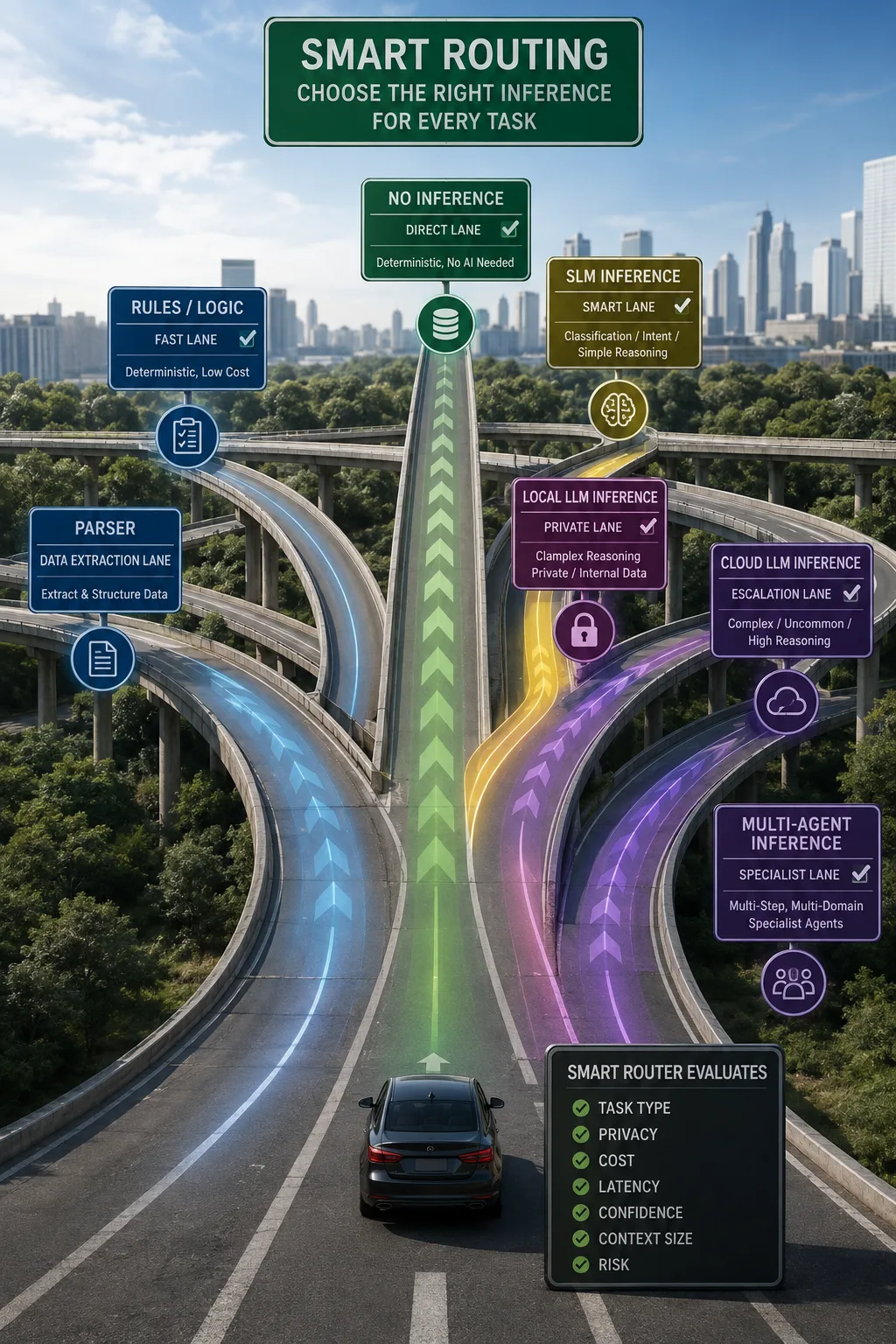
Many people think 智能路由 in AI is simply about choosing which model to use. In NeuralOps, we see it differently. 智能路由 determines the most appropriate type of inference for each task. Some tasks require no AI inference at all and can be handled through deterministic logic, business rules, database queries, or specialised parsers. Others may require an SLM for classification and intent detection, a local LLM for more complex private-data reasoning, a cloud LLM for difficult cases, or multiple specialist agents for higher-complexity 工作流.
The router evaluates factors such as task type, privacy, cost, latency, confidence, context size, and operational risk before deciding the execution path. A simple order-状态 lookup should not consume LLM 令牌. 发票提取 may only require a parser. 交易分类 may be handled by a small model. Larger models should only be activated when the task genuinely requires deeper reasoning.
This is why, in NeuralOps, 智能路由 is not just Model 路由. It is 推理 路由 + 执行 路由 + 验证 路由.
The objective is not to use as much AI as possible. The objective is to use the smallest, most efficient and most reliable level of intelligence required for each task.
#NeuralOps #SmartRouting #AIInfrastructure #推理 #EnterpriseAI #AIAutomation #LLM