AI 会计 NeuralOps is not about asking AI to do every accounting task manually.
That approach is expensive, slow, and honestly not smart.
In real accounting operations, many processes are repetitive and rule-based. 银行 reconciliation is a good example.
Instead of using AI to compare every transaction one by one, AI can generate the reconciliation logic or script first. 然后 the script can process thousands of records faster and cheaper.
AI should be used for intelligence, not brute-force execution.
This is where 智能路由 becomes important.
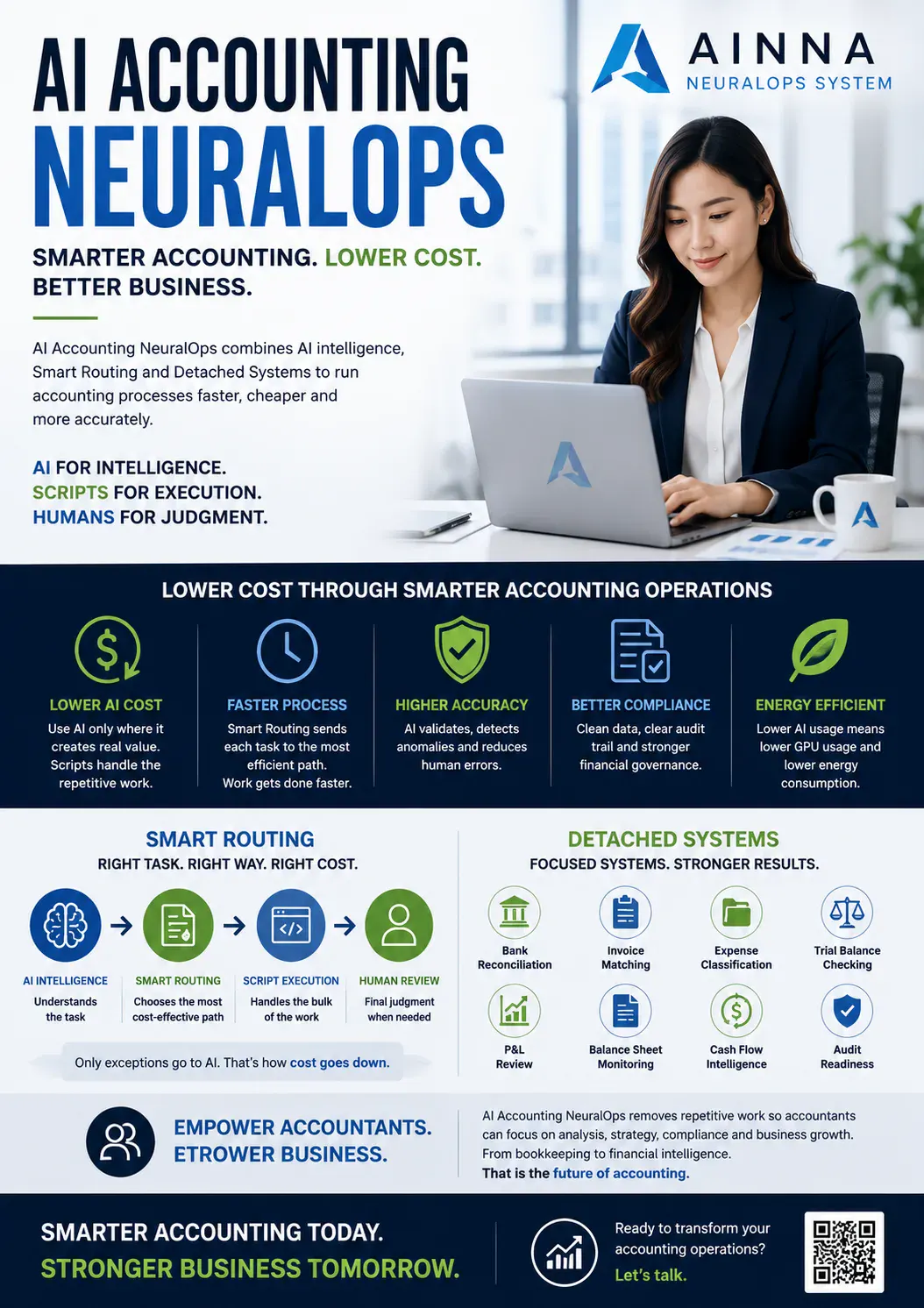
智能路由 decides whether a task should be handled by AI, a normal script, a smaller model, a stronger model, or human review.
For example, in bank reconciliation:
• AI generates the matching logic
• 脚本 runs the reconciliation process
• 分离式 系统 handles the workflow
• AI reviews unmatched or unusual transactions
• 人类 checks final judgment when needed
This reduces AI compute cost because the 系统 does not waste premium AI power on simple repetitive work.
分离式系统 make the process even cleaner.
Each accounting function can run as its own independent module, such as reconciliation, invoice matching, expense classification, trial balance checking, 损益表 review, balance sheet monitoring, and cash flow intelligence.
Each module does one job properly, scales independently, and connects back to the main NeuralOps layer when required.
That is the real value of AI 会计 NeuralOps.
AI for intelligence.
Scripts for execution.
智能路由 for cost control.
分离式系统 for scalability.
Humans for final decision-making.
The future of accounting is not just automation.
It is intelligent financial operations.