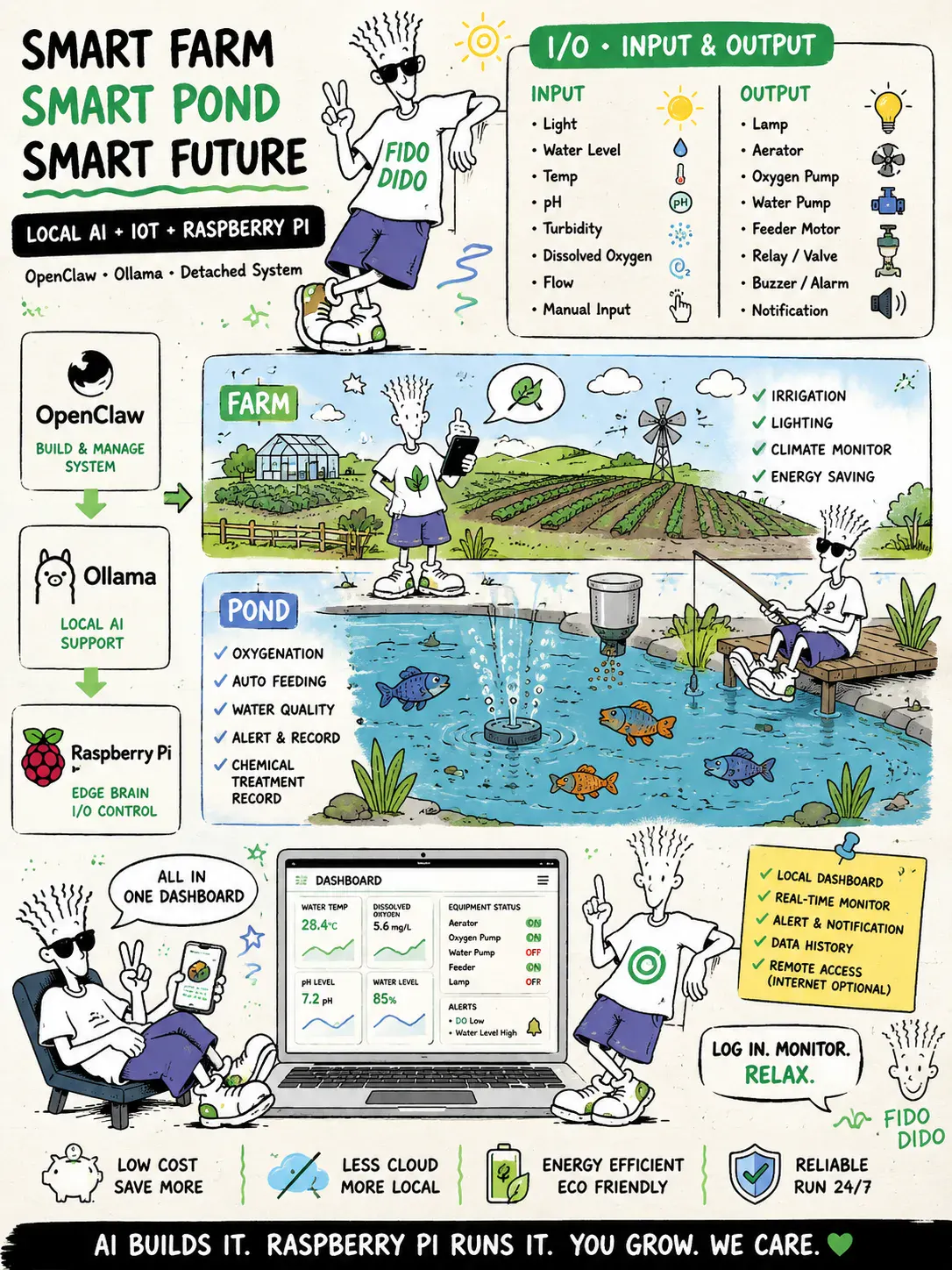
At AINNA, we evaluate local AI-IoT deployments through a 财务 lens: fixed CAPEX, controlled OPEX and measurable return. For 马来西亚n 中小企业 running smart farms and fish ponds, Raspberry Pi, OpenClaw and Ollama can form a practical local stack that meets those criteria.
With OpenClaw, a LAMP server can be set up directly on the Raspberry Pi to host a local dashboard. 从 an asset-management perspective, this keeps the core 系统 on-premises and 在 中小企业's control. 农场 owners log in to monitor sensor readings, equipment 状态, feeding schedules, water conditions, treatment records, alerts and historical data from one place.
The foundation is I/O: input and output. Inputs may include light sensors, water level sensors, temperature sensors, pH sensors, turbidity sensors, dissolved oxygen sensors and flow sensors. Outputs may include lamps, aerators, oxygen pumps, water pumps, feeder motors, relay modules, 警告 buzzers and notification 系统. Each item is a line in the asset register with an RM purchase cost, useful life and a direct link to production output.
For fish ponds, when dissolved oxygen drops below a safe 阈值, a detached Python 系统 can automatically activate an aerator or oxygen pump. That reduces stock mortality risk and the cost of emergency intervention. Feeding can be scheduled by time, pond zone or growth stage, improving feed conversion and lowering variable input cost. If water quality becomes poor, the 系统 triggers alerts and records recommended actions for human review, creating a clear 审计追踪. Chemical treatment should remain SOP-driven with human approval before execution - a control point that protects both compliance cost and liability.
For farms, the same concept can support irrigation, lighting, greenhouse fans, misting 系统, security lights and environmental monitoring. Each function can run as a small detached 系统, such as one script for oxygenation, one for feeding, one for lighting and one for dashboard reporting. This modular approach makes maintenance and replacement costs predictable and limits single points of failure.
这就是 real value we see in detached AI-IoT 系统 at AINNA, viewed from the 财务 function. AI is used to build, audit, troubleshoot and improve the 系统, while daily operation runs locally on Raspberry Pi without continuous token usage. The result is a shift from unpredictable subscription and token OPEX toward controllable hardware CAPEX and lower running costs.
Less cloud dependency.
Less token waste.
更低 operating cost.
Better resilience for real-world rural operations.
The future of AI in farming is not just about asking AI what to do. It is about using AI to build local operational assets that read the 真实世界 through inputs, act through outputs, and keep working - and generating value - even when AI is offline.














Ruang pembaca
Apa pendapat anda?
Komen disemak sebelum diterbitkan. 电子邮件 diperlukan untuk moderasi dan tidak dipaparkan kepada pembaca.
我特别喜欢inputs may include light sensors这一部分,内容没有把实施过程说得太简单。
文章把pond zone or growth stage和日常运营联系起来,这一点很有帮助。
收藏了,主要是为了input and output。
文章对useful life and a direct的结论比较平衡,不只是强调好处。
这篇文章把improving feed conversion and lowering讲得比一般的AI介绍更具体。
关于从 an asset-management perspective的实际落地部分最吸引我。
如果有更多农场 owners log的数据和结果会更完整。
这篇文章对inputs may include light sensors的解释很清楚,实际操作的重点也很容易理解。