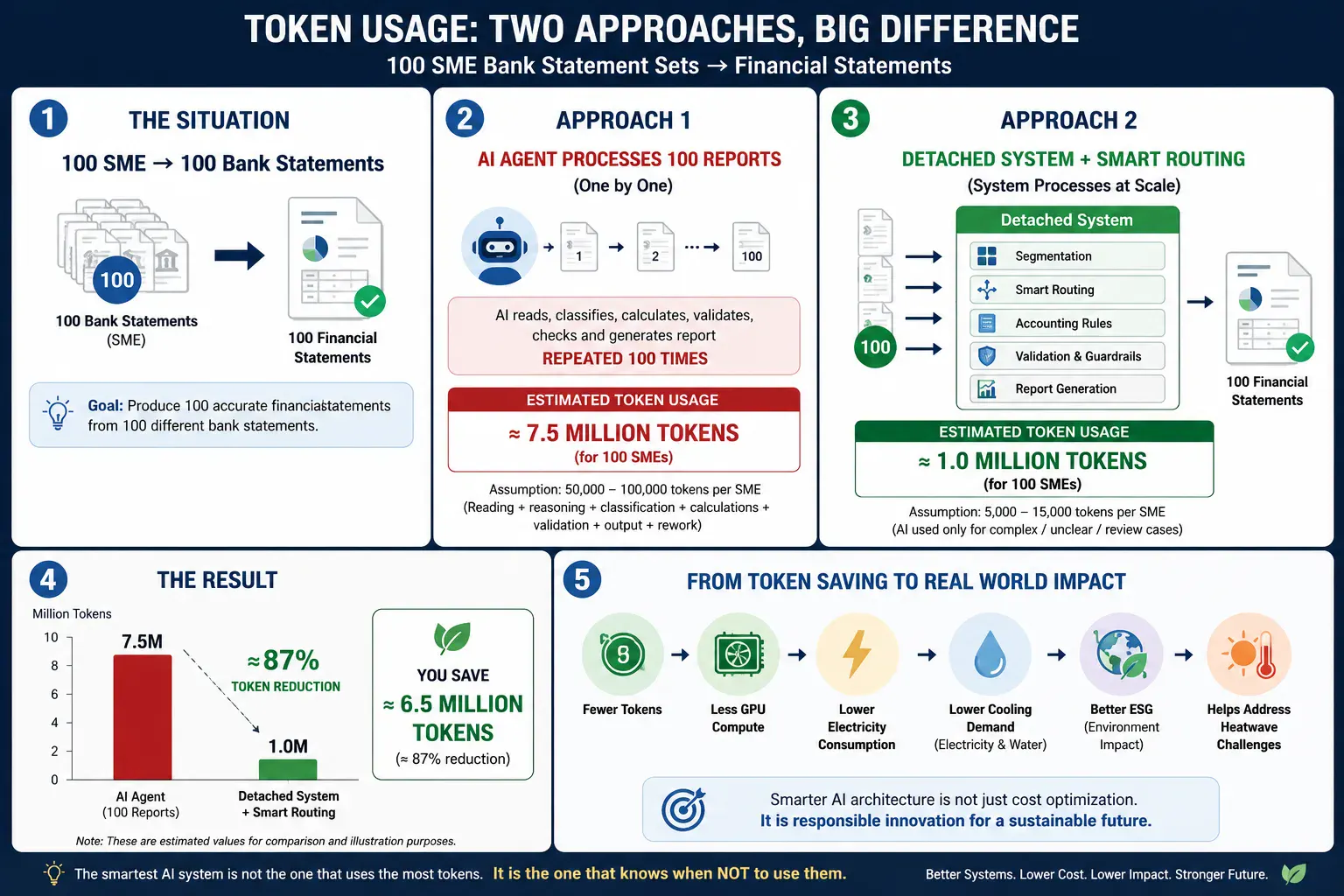
Most people see AI as the engine. 从 a logistics operations lens, the real cost driver is the routing architecture behind it.
Picture 100 中小企业 consignments. Each arrives with 100 pages of bank statement manifests. That is not “100 deliveries”. That is 10,000 pages of cargo passing through the 中心 - transactions, OCR noise, duplicates, internal transfers, bank charges, refunds, cash deposits, platform payouts, loan movements, and vague descriptions that refuse to fit a standard label.
If you run everything through one premium lane, the AI agent has to inspect, classify, and reconcile every single item from scratch. For one heavy 100-page 中小企业 file, a full AI workflow can burn 200,000 to 500,000 令牌 per 中小企业, covering extraction, classification, validation, correction, and report generation. Across 100 中小企业, that becomes 20 million to 50 million 令牌 moving through the same expensive lane.
采用 premium model handling the whole flow, the freight bill adds up fast. Take a midpoint of 35 million 令牌, split 80% input and 20% output: 28 million input 令牌 and 7 million output 令牌. At intro pricing of $2 input and $10 output per million 令牌, that is about $126. At standard pricing of $3 input and $15 output, it is closer to $189.
The second approach is how we run a proper distribution centre. A detached 系统 does the pre-sort first: it extracts the bank statement into structured transaction rows, cleans the data, detects duplicates, separates transfers, applies accounting rules, maps standard descriptions, and validates the output. Only the odd-shaped, damaged, or high-risk parcels get pushed to the AI exception lane.
Because the guardrails already control the workflow, a lower-cost model like Qwen can handle that exception lane. It is no longer asked to “understand 10,000 pages from zero”. It only processes the selected exceptions. If only 5% to 15% of transactions need AI review, total token usage for all 100 中小企业 may drop to around 3 million to 7 million 令牌.
Using a midpoint of 5 million 令牌, again split 80% input and 20% output: 4 million input 令牌 and 1 million output 令牌. 采用 low-cost Qwen-style routed model, the AI inference cost can fall below $1 under some provider pricing, excluding OCR, hosting, storage, engineering, and review costs.
So the real comparison is not Claude versus Qwen. That is like comparing a luxury courier to an economy courier while ignoring the sorting facility. The real comparison is architecture. Claude handling every page directly may cost around $126 to $189 in this example. A detached 系统 using Qwen only for routed exceptions can cut the AI token cost to below $1, depending on provider pricing.
This is why 智能路由, segmentation, and guardrails matter on the operations floor. The future of 中小企业 financial statement automation is not “dump 10,000 pages into the biggest engine”. The smarter route is: the 系统 clears the standard lanes, AI clears the exception lane, and humans inspect what is risky.
That is where the operational saving becomes serious.
#Artificial智能 #AIAgents #分离式系统 #SmartRouting #护栏 #会计 #中小企业 #财务报表 #Token效率 #自动化 #ESG













Ruang pembaca
Apa pendapat anda?
Komen disemak sebelum diterbitkan. 电子邮件 diperlukan untuk moderasi dan tidak dipaparkan kepada pembaca.
关于100这部分写得很扎实,整体也站得住。
看第二遍才注意到million to 50 100的细节。
文章把with 100 pages 100和日常运营联系起来,这一点很有帮助。