AI 财务 决策 Lab (AI-FDL)
An Ethical AI 驱动 财务 决策 模拟 平台 for Malaysian University 学生
Nur Syairah Ani*, Nur Hafizah Roslan, Nur Amirah Borhan, Azrizal Husin, Abd Razzif Abd Razak, Siti Nurulaini Azmi, Siti Faizah Zainal & Rafiatul Adlin Hj Mohd Ruslan — Faculty of 管理 and Economics, Universiti Pendidikan Sultan Idris, 霹雳, 马来西亚
A competition-ready ICAME 2026 Chapter in Book following the ICAME 2026 创新 竞争 master brief in full: forensic audit, eligibility verification, problem reconstruction, innovation stack, responsible-AI governance, validation roadmap, 已验证 references and a substantially extended manuscript. Every claim is honest — AI-FDL is a proposed innovation, and the chapter distinguishes what is demonstrated, designed, proposed and to be validated.
Abstract
用途. This chapter presents AI 财务 决策 Lab (AI-FDL), a proposed ethical AI-powered financial decision simulation platform designed to help Malaysian university students convert financial knowledge into sound financial behaviour through safe, repeated, personalised decision practice.
设计/methodology/approach. AI-FDL integrates financial decision simulation, behavioural 财务 analysis, an AI 财务 教练, a 财务 健康 仪表盘, gamification and personalised learning within a single educational decision laboratory. The innovation is developed through an integrated 设计 Thinking and ADDIE framework and 受治理的 by a Responsible AI framework covering transparency, explainability, human oversight, data minimisation, privacy, bias and fairness, hallucination control and a clear financial-education boundary.
Findings. As a proposed innovation, AI-FDL has not yet been developed, implemented or empirically tested. Its expected educational, behavioural, technological, commercial and research value is presented as a 设计 proposition, with a rigorous future validation roadmap (usability, financial-literacy change, decision quality, user acceptance, AI accuracy, AI safety, content validity and engagement) rather than claimed results.
Originality/value. The defensible novelty lies in the 系统-level integration of scenario simulation, behavioural-bias detection, explainable AI feedback, financial-health scoring, gamification, personalised learning and responsible-AI guardrails into one educational decision laboratory — transforming financial education from learning about money into learning through financial decisions.
关键词: financial literacy; financial decision-making; behavioural 财务; simulation-based learning; gamification; responsible AI; explainable AI; financial education; Malaysian university students; AI-FDL
PART A — 管理层 判定
AI-FDL is a conceptually strong, academically honest and competition-ready innovation proposal. Its principal strength is a defensible 系统-level novelty: the integration of 金融决策模拟、行为偏差检测、可解释AI反馈、财务健康评分、游戏化、个性化学习以及负责任的AI护栏 into a single educational decision laboratory for Malaysian university students.
The principal limitation is maturity. AI-FDL is a proposed innovation: it has not yet been developed, implemented or empirically tested. Award potential therefore depends on demonstrability. To compete credibly for a 黄金 Medal or Main Award, the team should prioritise a clickable prototype, a functioning scenario, an AI 财务 教练 demonstration, a 财务 健康 仪表盘, an ethics notice and a short demonstration video before final judging.
总体 award readiness is assessed as moderate-to-strong on concept and academic foundation, with the decisive gap being prototype evidence. This chapter is structured to maximise every controllable element of innovation judging while maintaining full academic integrity.
PART B — ICAME 2026 Eligibility 审计
已验证 against the official ICAME 2026 创新 竞争 page.
| ICAME 要求 | AI-FDL 状态 | 证据 | 风险 | 操作 必需 |
|---|---|---|---|---|
| 打开 to all | 合规 | 团队 of academics and researchers | 无 | 无 |
| 个人 or group, max 8 people | 合规 | 8 authors listed | 无 | 确认 final author count |
| 遵循 ICAME 2026 子主题 | 合规 (primary: Subtheme 1) | Ethical AI & Shariah 治理 in the 数字化 Economy | 主题契合度必须明确 | 将合乎伦理的AI作为首要对齐目标 |
| Participation in 马来语 or 英语 | 合规 | Chapter written in 英语 | 无 | 无 |
| 已获席位 virtually, online evaluation | 合规 | 通过视频和章节提交 | 无 | 准备 online presentation |
| 于2026年8月1日前完成注册并提供付款凭证 | To be confirmed | 团队 to confirm | Deadline risk | 确认 registration 状态 |
| 录取通知书截止 2026 年 8 月 15 日 | To be confirmed | 团队 to confirm | Deadline risk | 监控 email |
| 分录 fee RM250 | To be confirmed | 团队 to confirm | Payment risk | 确认 payment |
| 创新 Video + Chapter by 31 Aug 2026 | In progress | 章节已准备;待制作视频 | Deadline risk | 制作含20秒片头蒙太奇的视频 |
| 视频必须包含20秒片头蒙太奇 | To be produced | Official montage provided | 合规 risk | 在开头插入官方蒙太奇 |
| Chapter in Book template | 合规 | 遵循官方模板结构 | Formatting risk | 严格匹配模板标题 |
来源: official ICAME 2026 创新 竞争 page. Dates and fees are as published and must be re-confirmed by the team.
Primary subtheme selection. AI-FDL is positioned primarily under Subtheme 1: Ethical AI & Shariah 治理 in the 数字化 Economy, because the innovation's title and architecture foreground ethical and responsible AI in the digital economy. The ethical-AI governance framework is a substantive, integrated component rather than a superficial label.
Secondary alignment. A defensible secondary alignment is Subtheme 3: 可持续 价值 Creation, ESG & Islamic Economics, through the SDG 4 and SDG 8 contribution and the promotion of financially responsible, resilient graduates. Islamic 财务 or Shariah elements are not forced into the innovation; they are incorporated only where genuinely relevant (for example, takaful/insurance scenarios in Module 1).
PART C — Existing 文档 Forensic 审计
针对现有 AI-FDL 章节在各关键评审领域进行的诊断性审查。
| 面积 | 当前 位置 | 优势 | Weakness / 风险 | Award Implication | 必需 Correction | 优先级 |
|---|---|---|---|---|---|---|
| 标题 | Ethical AI 驱动 财务 决策 模拟 平台 | 清空, thematic | 篇幅较长;创新点不够一目了然 | 中等 | 考虑一个更精炼的标题(见第G部分) | 中等 |
| 创新 identity | AI-FDL brand established | Distinctive | 无 | 高 | Retain brand | Low |
| 问题 statement | 泛化的低金融素养框架 | Relevant | 缺乏分层,也缺乏充分证据 | 高 | 采用五层问题架构 | 高 |
| Malaysian context | PTPTN, BNPL, e-wallets | Strongly localised | 可以补充更多证据 | 高 | 在可核实之处补充马来西亚统计数据 | 中等 |
| 目标 users | Malaysian university students | 清空 | 无 | 高 | Retain | Low |
| 证据 for problem | 文献 citations | 当前 | Some references weak | 高 | Replace unverified references | 高 |
| 文献 foundation | Moderate | Relevant | Needs strengthening | 高 | Add 已验证 sources | 高 |
| Theoretical foundation | Behavioural 财务, experiential learning | Appropriate | 设计 Thinking/ADDIE not theories | 中等 | 将理论与方法论分开 | 高 |
| 创新 gap | 已有陈述,但尚未展示 | 当前 | 进展路径不清晰 | 高 | 构建 Existing→限制→Need→解决方案 | 高 |
| Novelty | Uses AI | Honest | Under-articulated | 高 | 定义 系统-level integration + stack | 高 |
| Uniqueness | Implied | 当前 | Not evidenced | 高 | 竞争者对比表 | 高 |
| Competitive differentiation | Not developed | — | 缺失 | 高 | 增加能力对比 | 高 |
| AI architecture | LLM + rule-based | Reasonable | Not layered | 高 | 当前 8-layer stack | 高 |
| 财务 simulation | RM1,800 PTPTN example | Concrete | Single example | 中等 | 增加场景范围 | 中等 |
| Behavioural 财务 | 当前 bias, overconfidence, etc. | Relevant | 语言 could overclaim | 高 | 使用“与……一致”的表述 | 高 |
| Gamification | Mentioned | 当前 | Not motivational mechanism | 中等 | 解释 mechanism, not badges | 中等 |
| AI 财务 教练 | Described | 清空 | Boundaries need clarity | 高 | 明确教育与咨询的区别 | 高 |
| 财务 健康 仪表盘 | Scores listed | Useful | Scores not validated | 高 | 标注为原型指标 | 高 |
| Responsible AI | Mentioned | 当前 | Not substantive | 高 | 开发 10-principle framework | 高 |
| Explainability | Implied | 当前 | Not explicit | 高 | Make explicit | 高 |
| 隐私政策 | Mentioned | 当前 | Not detailed | 高 | 详情 data minimisation | 高 |
| 数据 governance | Mentioned | 当前 | Not detailed | 中等 | 详情 governance | 中等 |
| 财务-advice risk | 已确认 | 当前 | Needs emphasis | 高 | 强调教育边界 | 高 |
| Methodology | 设计 Thinking + ADDIE | Appropriate | Not integrated | 高 | Map DT to ADDIE | 高 |
| 设计 Thinking | Used | Appropriate | Not mapped | 中等 | Map stages | 中等 |
| ADDIE | Used | Appropriate | Not mapped | 中等 | Map stages | 中等 |
| Prototype maturity | Proposed only | Honest | No demonstrable prototype | 高 | 优先构建原型 | 高 |
| 验证 | Proposed | Honest | No results | 高 | 当前 validation roadmap | 高 |
| Effectiveness | Expected only | Honest | No results | 高 | 区分预期结果与已展示结果 | 高 |
| Measurable outcomes | Listed | 当前 | Not operationalised | 高 | 定义 measures/methods | 高 |
| Educational value | Strong | 当前 | 无 | 高 | Retain | Low |
| 社会 impact | SDG 4, 8 | 当前 | Could be deeper | 中等 | 增加因果路径 | 中等 |
| SDG alignment | SDG 4, 8 | Appropriate | 避免只罗列名称 | 中等 | 解释 causal pathway | 中等 |
| 可扩展性 | UPSI→ASEAN | 当前 | Not detailed | 中等 | 详情 per-stage modification | 中等 |
| Commercialisation | Models listed | 当前 | Not a business model | 高 | 开发 credible model | 高 |
| 可持续发展 | Implied | 当前 | Not explicit | 中等 | Make explicit | 中等 |
| IP potential | Not addressed | — | 缺失 | 中等 | Add IP strategy | 中等 |
| 研究 potential | Strong | 当前 | 无 | 中等 | Retain | Low |
| 引用 | 当前 | Relevant | Some unverified | 高 | 校验 all | 高 |
| 参考文献 | 19 listed | Relevant | 2 unverified, 1 misattributed | 高 | 正确/remove (see Part D) | 高 |
| 语言 | 英语 | 清空 | Minor polish | 中等 | Proofread | 中等 |
| 结构 | 5 sections | Logical | Could be richer | 中等 | 展开 per template | 中等 |
| Visual presentation | Minimal | — | No figures | 高 | 增加图表(见 J 部分) | 高 |
| 总体 competition readiness | 概念 strong, evidence thin | Honest | Prototype gap | 高 | 构建 prototype + video | 高 |
基于现有 AI-FDL 章节及既有的国际创新竞赛评审惯例而进行的诊断性审查。
PART D — Citation and Reference 验证
Every reference in the existing chapter was 已验证 against Crossref, DOI.org and publisher sources.
| Existing Reference | Exists? | Citation 正确? | DOI 已验证? | 来源 质量 | 判定 |
|---|---|---|---|---|---|
| Ajzen (2020), HBET 2(4) | Yes | Yes | Yes (10.1002/hbe2.195) | Peer-reviewed journal | Retain (add DOI) |
| Lusardi & Messy (2023), JFLW 1(1) | Yes | Yes | Yes (10.1017/flw.2023.8) | Peer-reviewed journal | Retain (add DOI) |
| FINCO (2023) Money SENse | Yes | Yes | N/A (report) | NGO report | Retain |
| Mat Rahim et al. (2022) | Yes | No — wrong journal/pages | Yes (10.35609/gcbssproceeding.2022.1(9)) | Conference proceeding | 正确 |
| Choukhmane et al. (2026) | Yes | Yes | Yes (10.2139/ssrn.7257643) | SSRN preprint | Retain (add DOI) |
| Elisabeth et al. (2026), IRASET | Yes | Yes | Yes (10.1109/IRASET68627.2026.11538502) | IEEE proceedings | Retain (add DOI) |
| Tanjung et al. (2026), ARJ 15(2) | No | No | No (DOI 404) | Unverified | Remove |
| Adwani & Chermala (2026), ECOFIN | Yes | Yes | N/A (proceedings) | Conference proceedings | Retain (add ISBN) |
| Yansah & Sayuti (2025) | No | No — wrong authors/pages | No (misattributed) | Misattributed | 正确 to Wijaya (2025) |
| World Economic Forum (2024) | Yes | Yes | N/A (report) | 机构 report | Retain (add URL) |
| Aziz & Kassim (2020) | Yes | 日志 name off | Yes (10.35631/aijbaf.22002) | Peer-reviewed journal | 正确 journal name |
| Kanzal et al. (2026), Springer | Plausible | Unverified | Unverified | Book chapter | Retain (verify before submission) |
| 银行 Negara 马来西亚 (2025) NS2.0 | Yes | Yes | N/A (policy) | 政府 report | Retain |
| Osman, Raj & Paydibs (2024) | No | No | No | Not found | 删除(替换为 Osman 等人,2024,IMBR) |
| Malik et al. (2025), RAMSS 8(2) | Yes | Yes | Yes (10.47067/ramss.v8i2.542) | Peer-reviewed journal | Retain (add DOI) |
| Forcellini & Gracikova (2025) | Yes | Yes | Yes (10.55121/jbep.v1i1.766) | Peer-reviewed journal | Retain (add DOI) |
| Chahar et al. (2026), SSRN | Yes | Yes | Yes (10.2139/ssrn.6377518) | SSRN preprint | Retain (add DOI) |
| 分店 (2009), ADDIE | Yes | Yes | Yes (10.1007/978-0-387-09506-6) | Springer monograph | Retain (add DOI) |
| Brown (2008), HBR | Yes | Yes | N/A (HBR) | Practitioner magazine | Retain |
验证 conducted against Crossref, DOI.org and publisher sources. Two references were removed and one corrected; the corrected and 已验证 reference list appears in Part I.
PART E — 创新 Gap 分析
妨碍 AI-FDL 成为主奖项级创新的,并非其概念,而是可演示性方面证据的不足。
目前妨碍 AI-FDL 成为主奖项级创新的,并非其概念,而是可演示性方面证据的不足。概念本身十分扎实:在现有的各类解决方案中,没有哪一类能够为马来西亚大学生整合逼真的情境模拟、后果建模、行为偏差分析、可解释AI反馈、财务健康评分、游戏化以及负责任的AI护栏。
The gap is threefold. 首先, prototype maturity: AI-FDL exists as a 设计, not a working 系统. Second, empirical validation: no usability, learning-outcome or AI-safety results exist. Third, competitive differentiation: the chapter must demonstrate, not merely assert, how AI-FDL differs from budgeting apps, generic AI chatbots and investment simulators.
结束 this gap requires a clickable prototype, a functioning scenario with an AI 财务 教练 demonstration, a 财务 健康 仪表盘, an ethics notice and a short demonstration video. These are achievable before judging and would transform the submission from a proposal into a demonstrable innovation.
PART F — Novelty Reconstruction
The defensible novelty is a 系统-level integration, not the use of AI itself.
The defensible novelty of AI-FDL is a 系统-level integration, not the use of AI itself. The innovation contribution is defined as the integration of eight 层 into one educational decision laboratory:
Layer 1 — 场景 引擎: 真实的学生财务情境。 Layer 2 — 决策 引擎: 捕捉分配与财务选择。 Layer 3 — Consequence 模拟 引擎: 模拟潜在的财务后果。 Layer 4 — Behavioural 财务 引擎: 检测与所选行为偏差相符的决策模式。 Layer 5 — 财务 健康 分析 引擎: 生成相关的模拟指标。 Layer 6 — AI 财务 教练: 解释决策并提供教育性反馈。 Layer 7 — Ethical AI Guardrail: 管控范围、透明度、隐私以及不当财务建议的生成。 Layer 8 — Learning 分析: 衡量学习进展与学习成果。
Every major novelty claim was tested against the question: Could a judge challenge this statement? Claims such as first in 马来西亚, only platform, revolutionary or proven are avoided unless independently 已验证. The chapter uses qualified, evidence-based language throughout.
PART G — Final 推荐 标题
Five alternative titles evaluated against novelty visibility, clarity, academic credibility, memorability, innovation identity, competition appeal and ICAME thematic alignment.
1. AI 财务 决策 Lab (AI-FDL): An Ethical AI 驱动 财务 决策 模拟 平台 for Malaysian University 学生 — the current title; clear and thematic but long.
2. AI-FDL: Learning Through 财务 Decisions — An Ethical AI 模拟 平台 for Malaysian University 学生 — shorter, memorable, foregrounds the learning-through-decisions proposition.
3. 从 财务 知识 to 财务 行为: The AI 财务 决策 Lab (AI-FDL) for Malaysian University 学生 — foregrounds the knowing–doing gap.
4. AI-FDL: A Responsible-AI 财务 决策 Laboratory for Malaysian University 学生 — foregrounds responsible AI, aligning with Subtheme 1.
5. The AI 财务 决策 Lab (AI-FDL): 模拟中 财务 Decisions to 构建 Financially Resilient Malaysian Graduates — foregrounds the graduate outcome.
Recommendation. Retain the AI-FDL brand and adopt a sharper formulation that foregrounds the learning-through-decisions proposition and the ethical-AI identity. The recommended final title is: AI 财务 决策 Lab (AI-FDL): An Ethical AI 驱动 财务 决策 模拟 平台 for Malaysian University 学生, with the innovation proposition 通过财务决策学习 作为本章的中心框架性表述。
PART H — 完成 Revised ICAME 2026 Chapter
依据官方 ICAME《书内章节》模板完成全稿修订的完整手稿。
AI 财务 决策 Lab (AI-FDL): An Ethical AI 驱动 财务 决策 模拟 平台 for Malaysian University 学生
ICAME 2026 创新 竞争 — Chapter in Book
Nur Syairah Ani¹*, Nur Hafizah Roslan², Nur Amirah Borhan³, Azrizal Husin⁴, Abd Razzif Abd Razak⁵, Siti Nurulaini Azmi⁶, Siti Faizah Zainal⁷ & Rafiatul Adlin Hj Mohd Ruslan⁸
¹⁻⁷Fakulti Pengurusan dan Ekonomi, Universiti Pendidikan Sultan Idris, 35000, Tg Malim, 霹雳 · ⁸Universiti Utara 马来西亚, Kuala Lumpur Campus, 50300 马来西亚 · *Corresponding email: nursyairah@fpe.upsi.edu.my
Abstract
用途. This chapter presents AI 财务 决策 Lab (AI-FDL), a proposed ethical AI-powered financial decision simulation platform designed to help Malaysian university students convert financial knowledge into sound financial behaviour through safe, repeated, personalised decision practice.
设计/methodology/approach. AI-FDL integrates financial decision simulation, behavioural 财务 analysis, an AI 财务 教练, a 财务 健康 仪表盘, gamification and personalised learning within a single educational decision laboratory. The innovation is developed through an integrated 设计 Thinking and ADDIE framework and 受治理的 by a Responsible AI framework covering transparency, explainability, human oversight, data minimisation, privacy, bias and fairness, hallucination control and a clear financial-education boundary.
Findings. As a proposed innovation, AI-FDL has not yet been developed, implemented or empirically tested. Its expected educational, behavioural, technological, commercial and research value is presented as a 设计 proposition, with a rigorous future validation roadmap rather than claimed results.
Originality/value. The defensible novelty lies in the 系统-level integration of scenario simulation, behavioural-bias detection, explainable AI feedback, financial-health scoring, gamification, personalised learning and responsible-AI guardrails into one educational decision laboratory — transforming financial education from learning about money into learning through financial decisions.
关键词: financial literacy; financial decision-making; behavioural 财务; simulation-based learning; gamification; responsible AI; explainable AI; financial education; Malaysian university students; AI-FDL
1. 简介
财务 literacy is an essential life skill in today's rapidly changing digital economy (Lusardi & Messy, 2023). Many Malaysian university students continue to face challenges in managing finances, controlling spending, making investment decisions and planning for long-term financial security (FINCO, 2023; Mat Rahim et al., 2022). At the same time, the growing use of AI 工具 such as ChatGPT and Gemini has changed how students access financial information, creating a need for digital financial literacy to help them distinguish reliable information from inaccurate or potentially biased AI-generated content (Choukhmane et al., 2026; Elisabeth et al., 2026; Mat Rahim et al., 2022).
传统 financial education mainly relies on lectures and passive online materials, which may provide limited opportunities for students to practise financial decisions and experience their potential longer-term consequences in a safe environment (FINCO, 2023; Ajzen, 2020). To address this gap, AI 财务 决策 Lab (AI-FDL) is proposed as an interactive AI-powered simulation platform that combines 人工智能, Behavioural 财务, financial literacy education and gamification. 学生 will be able to simulate realistic financial situations, evaluate potential outcomes and receive personalised feedback and recommendations from an AI 财务 教练.
The proposed innovation supports responsible use of AI in financial education and contributes to AI-driven higher education. It is aligned with SDG 4 (质量 教育) and SDG 8 (Decent Work and Economic 增长) by supporting the development of financially responsible, resilient and future-ready graduates (World Economic Forum, 2024; Wijaya, 2025).
2. 背景 of 创新
五层问题架构:知识缺口、知行差距、行为偏差、数字金融的复杂性以及传统金融教育自身的局限。
Numerous studies have reported relatively low levels of financial literacy among Malaysian youth, particularly in budgeting, debt management, investment planning, retirement preparation and financial risk assessment (Aziz & Kassim, 2020; 银行 Negara 马来西亚, 2025). At the same time, the growth of Buy Now Pay Later (BNPL), digital lending, online investment platforms and cryptocurrency has made personal financial management more complex for young adults (Kanzal et al., 2026; Osman et al., 2024). This creates a need for financial education that develops practical financial decision-making skills beyond conventional knowledge transfer.
Although various financial education applications provide educational content, budgeting calculators and financial tracking, many offer limited opportunities for personalised learning, behavioural analysis and interactive decision-making simulations (Adwani & Chermala, 2026). To address this gap, AI 财务 决策 Lab (AI-FDL) is proposed as a simulation-based platform where students can practise financial decisions in realistic scenarios. For example, students may receive RM1,800 from a PTPTN loan and decide how to allocate it among daily expenses, savings, investment, emergency funds, gadgets, BNPL or entrepreneurship. The proposed AI 系统 will simulate the potential effects of these choices on indicators such as 财务 健康评分, savings growth, debt ratio, investment performance, credit risk, emergency fund adequacy and retirement readiness.
AI-FDL will also incorporate Behavioural 财务 Theory to help students recognise factors that may influence their financial choices, including present bias, overconfidence, loss aversion, herd behaviour and emotional spending (Malik et al., 2025; Forcellini & Gracikova, 2025). Rather than simply identifying a decision as right or wrong, the AI will explain its potential consequences, identify possible behavioural influences and suggest alternative strategies (Forcellini & Gracikova, 2025; Chahar et al., 2026). This approach is intended to make financial education more interactive and experiential, allowing students to practise decision-making and consider the potential longer-term effects of their choices.
作为一项拟议的创新,AI-FDL 尚未被开发、实施或经过实证检验。其有效性、可用性、学习成果和用户接受度将通过后续的原型开发和小规模试点测试进行评估,并以此完善该平台。
2.1 问题 架构
五个相互作用的层次说明了为什么仅有知识不足以形成良好的财务行为。
Layer 1 — 财务 知识 Gap
学生 may possess theoretical financial knowledge without sufficient ability to apply it to complex, real-world decisions.
第 2 层——知行差距
了解正确的金融原则,并不必然转化为健全的金融行为。
Layer 3 — Behavioural 偏置
财务 decisions may be influenced by present bias, overconfidence, loss aversion, herd behaviour and impulsive or emotional spending.
Layer 4 — 数字化 财务 复杂度
学生 increasingly encounter BNPL, e-wallets, digital credit, online investing and AI-generated financial guidance.
Layer 5 — 限制 of 传统 教育
传统 lectures and static learning resources cannot always allow students to repeatedly experience the long-term consequences of financial decisions without actual financial loss.
综合来看,这些层面在逻辑上共同指向对这样一个平台的需求: 安全、个性化、基于行为模拟的金融决策实验室 ——AI-FDL 的核心主张。
3. 创新 Gap
现有金融教育 → 局限性 → 未被满足的需求 → AI-FDL 解决方案。
Existing solutions fall into several categories, each addressing part of the problem but none integrating the full decision-learning loop. Budgeting applications track spending but do not teach decision consequences. 财务 literacy applications deliver content but rarely provide realistic, repeated decision practice. Robo-advisers automate investment but are advisory, not educational, and are not designed for students. 财务 calculators compute outcomes but do not explain behavioural influences. Gamified learning applications motivate engagement but often lack financial realism and behavioural analysis. AI chatbots answer questions but may hallucinate and are not grounded in a 已验证 financial knowledge base. 投资 simulators practise trading but do not cover the full range of student financial decisions. University financial education programmes are typically lecture-based and passive.
未被满足的需求是一个整合了以下能力的统一平台: 逼真的情境模拟、后果建模、行为偏差分析、可解释AI反馈、财务健康评分、游戏化元素以及负责任的AI护栏 这些能力需适配马来西亚大学生的具体情境。AI-FDL 的设计目标正是将这些能力整合为一个教育决策实验室,填补上述空白。
Table H1: Capability 对比 of Existing 解决方案 分类
| Capability | 传统 财务 教育 | Budgeting App | Generic AI 聊天机器人 | 投资 Simulator | AI-FDL |
|---|---|---|---|---|---|
| 财务 knowledge | Yes | 部分 | 部分 | 部分 | Yes |
| 场景 simulation | No | No | No | 部分 | Yes |
| Consequence modelling | No | No | No | 部分 | Yes |
| Behavioural bias analysis | No | No | No | No | Yes |
| Personalised AI feedback | No | No | 部分 | No | Yes |
| 财务 health indicators | No | 部分 | No | 部分 | Yes |
| Gamification | No | 部分 | No | 部分 | Yes |
| Educational safeguards | Yes | No | No | No | Yes |
| Ethical AI | N/A | No | 部分 | No | Yes |
| Learning analytics | No | No | No | No | Yes |
| Malaysian student contextualisation | 部分 | No | No | No | Yes |
| 机构 deployment | Yes | No | No | No | Yes |
对比 based on publicly available information about each solution category. Where evidence is insufficient, the entry reflects the general capability of the category rather than a specific product.
4. Novelty and 价值 Proposition
The defensible novelty is a 系统-level integration, not the use of AI itself.
AI-FDL 的创新之处并不在于它使用了AI。其站得住脚的创新在于整合了以下元素: 金融决策模拟、行为偏差检测、可解释AI反馈、财务健康评分、游戏化、个性化学习以及负责任的AI护栏 into one educational decision laboratory. This is expressed as an academically defensible AI-FDL 创新 技术栈.
Layer 1 — 场景 引擎: 真实的学生财务情境。 Layer 2 — 决策 引擎: 捕捉分配与财务选择。 Layer 3 — Consequence 模拟 引擎: 模拟潜在的财务后果。 Layer 4 — Behavioural 财务 引擎: 检测与所选行为偏差相符的决策模式。 Layer 5 — 财务 健康 分析 引擎: 生成相关的模拟指标。 Layer 6 — AI 财务 教练: 解释决策并提供教育性反馈。 Layer 7 — Ethical AI Guardrail: 管控范围、透明度、隐私以及不当财务建议的生成。 Layer 8 — Learning 分析: 衡量学习进展与学习成果。
创新 proposition: AI-FDL 将金融教育从“学习关于金钱的知识”转变为“通过金融决策来学习”。
5. AI-FDL 架构 and 决策 循环
一种将 AI-FDL 与被动式金融教育区分开来的闭环机制。
The AI-FDL 决策 Learning 循环 is the mechanism through which students learn by doing. Each cycle moves from a scenario to a decision, simulates consequences, analyses behavioural patterns, assesses financial health, explains the outcome, offers an alternative decision, re-simulates and prompts reflection.
场景 → Student 决策 → 财务 Consequence 模拟 → Behavioural 模式 分析 → 财务 健康 评估 → AI Explanation → 备选 决策 → Re-模拟 → Reflection → Learning.
正是这种闭环机制使 AI-FDL 区别于被动式金融教育:学生可在安全的环境中反复体验自己选择的后果。
6. Development Methodology
An integrated 设计 Thinking and ADDIE framework.
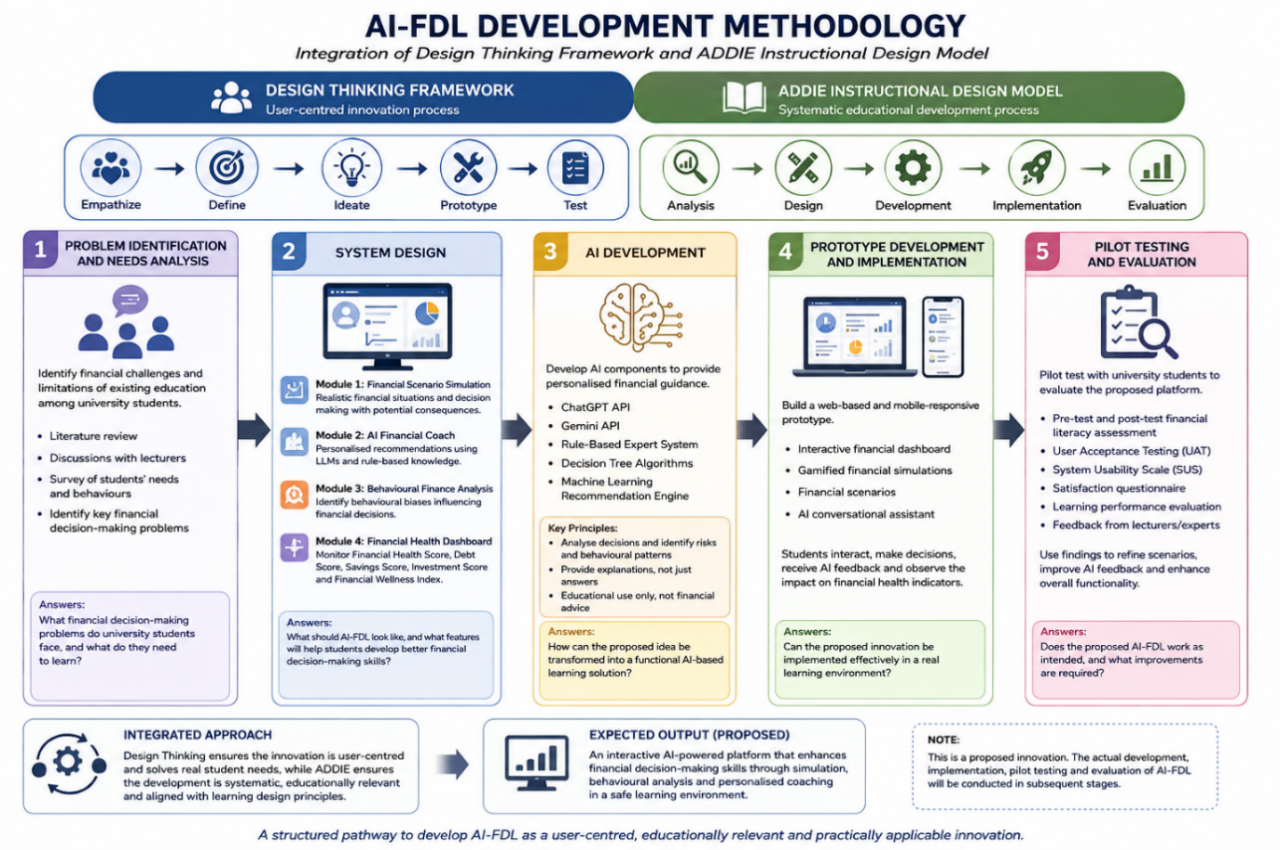
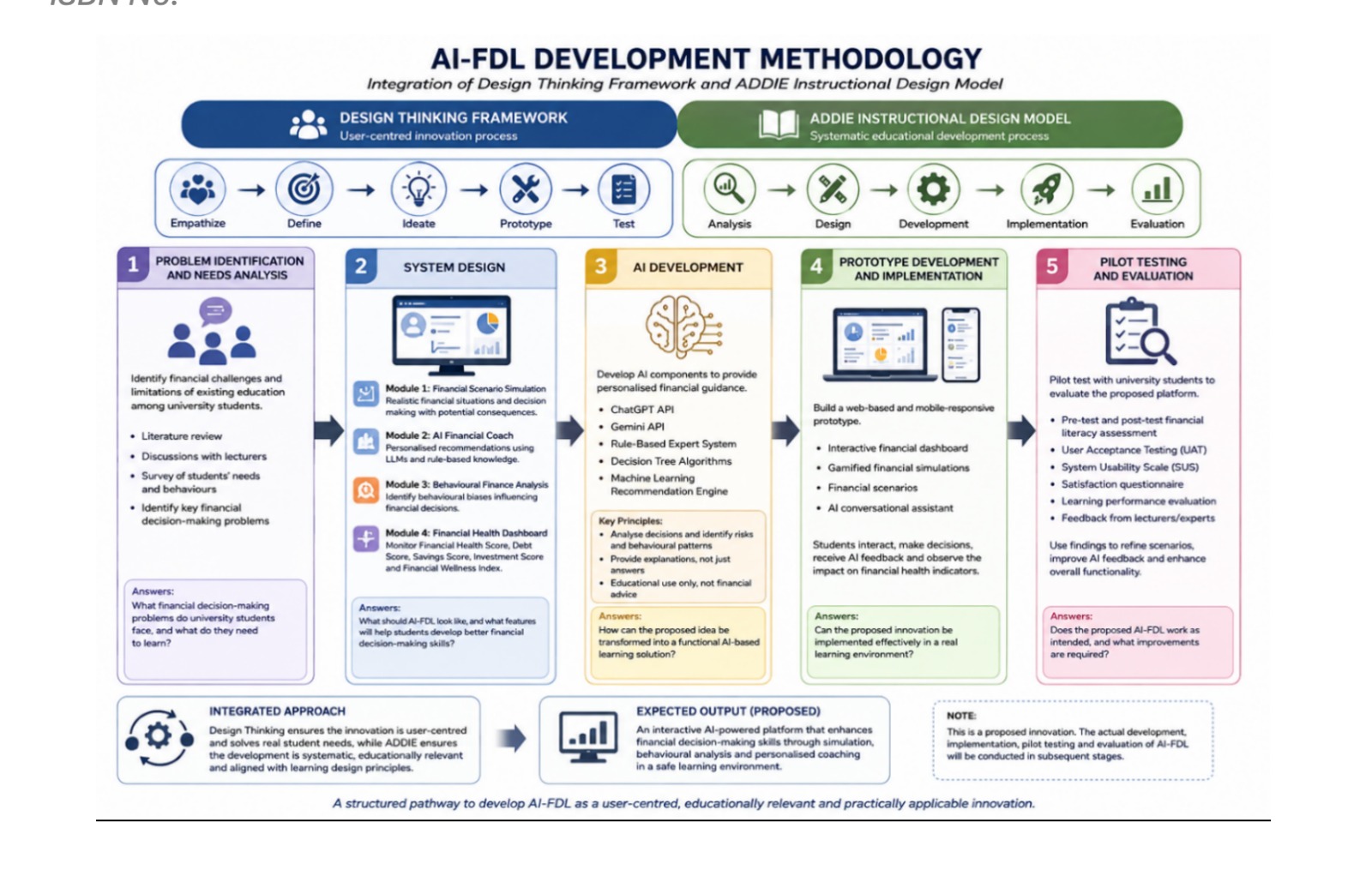
The proposed development of AI-FDL follows a combination of the 设计 Thinking framework and the ADDIE Instructional 设计 模型. 设计 Thinking provides a user-centred approach to innovation that focuses on understanding users' needs, defining problems, generating ideas, developing prototypes and testing potential solutions (Brown, 2008). The ADDIE model provides a systematic approach to developing educational innovations through five stages: 分析, 设计, Development, 实施 and Evaluation (分店, 2009). For AI-FDL, 设计 Thinking guides the identification of students' financial decision-making needs and the generation of an appropriate innovation, while ADDIE provides a structured process for designing, developing, implementing and evaluating the proposed educational platform.
7. AI-FDL 模块
四个核心模块共同带来决策学习的体验。
Module 1 — 财务 场景 模拟
贴近真实的学生情境:PTPTN、奖学金、每月生活费、兼职收入、应急支出、购买智能手机、BNPL、储蓄、投资、回教保险/保险、创业以及意外的财务冲击。
Module 2 — AI 财务 教练
Personalised recommendations generated using 大 语言 Models combined with rule-based financial knowledge. Educational rather than advisory, with explainability, safeguards, a 已验证 knowledge base, feedback and human oversight.
Module 3 — Behavioural 财务 分析
识别与现时偏好、过度自信、损失厌恶、从众行为和情绪化消费相符的决策模式——采用学术上审慎的语言,而非心理诊断。
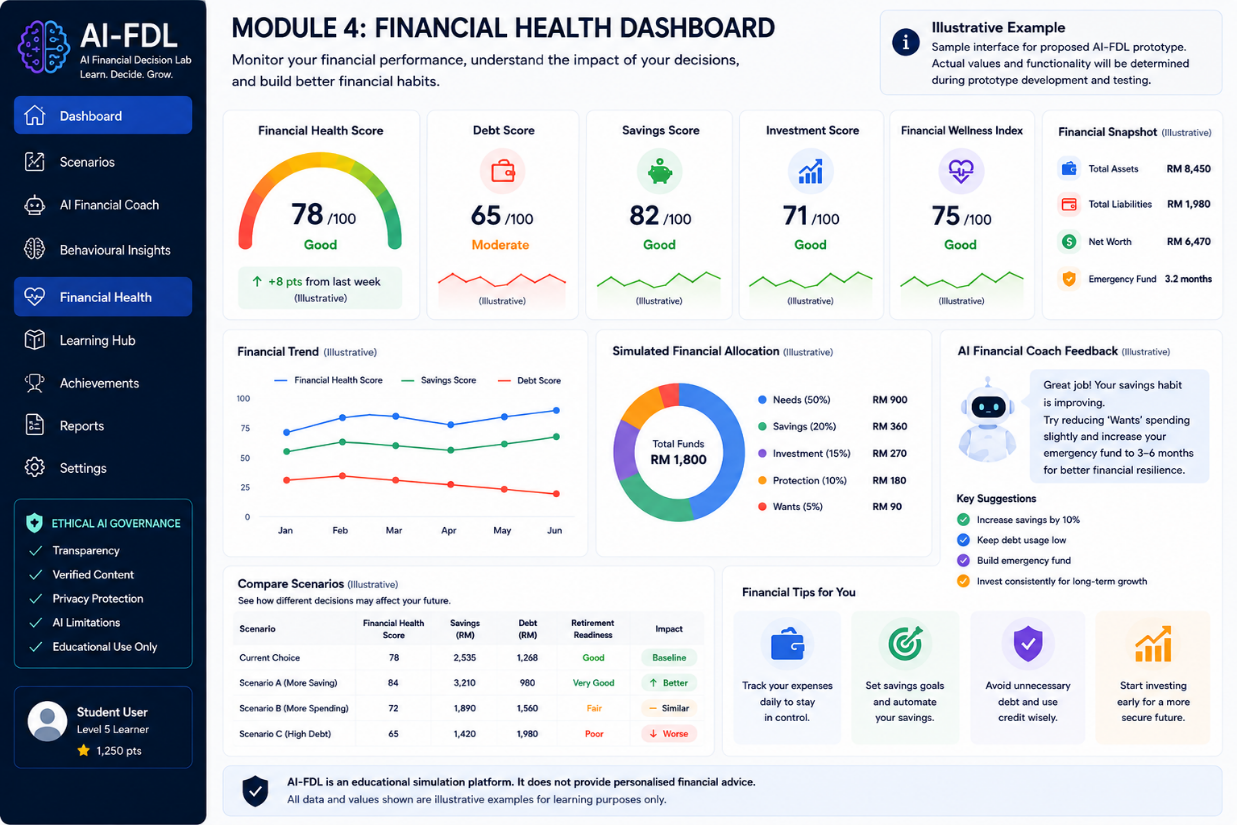
Module 4 — 财务 健康 仪表盘
Monitors simulated performance through 财务 健康评分, Debt 分数, 储蓄 分数, 投资 分数 and 财务 Wellness Index — labelled as prototype indicators, not validated measures.
8. Responsible AI 治理
Because "Ethical AI 驱动" is in the title, ethical AI is a major competitive advantage, not a disclaimer.
Because the phrase Ethical AI 驱动 appears in the innovation title, ethical AI cannot remain merely a disclaimer. AI-FDL embeds a substantive Responsible AI 治理 框架 addressing ten principles.
Transparency. 学生 must know they are interacting with AI. Explainability. 反馈 should explain reasoning rather than simply provide recommendations. 人类 Oversight. 讲师或经授权的管理员应拥有适当的监督权。 数据 Minimisation. 仅收集学习所必需的信息。 隐私政策. 保护学生信息。 安全. 根据原型的成熟度应用合理的控制措施。 偏置 and Fairness. 测试 scenarios and outputs for unfair or systematically misleading recommendations. 幻觉 控制. Use 已验证 financial knowledge and appropriate grounding or rule-based safeguards. 财务 Advice 边界. AI-FDL 必须明确区分金融教育与受监管的或个性化的财务建议。 用户 Autonomy. The 系统 should educate rather than dictate financial choices. Accountability. 定义 responsibility for content validation and 系统 governance.
9. 验证 and Evaluation 路线图
严谨的未来验证计划——不宣称任何结果。
Because AI-FDL has not yet been empirically tested, this chapter presents a rigorous future validation roadmap rather than claimed results. Each dimension specifies a 测量, a method and an indicative success criterion. These are proposed thresholds, not achieved results.
Table H2: AI-FDL 验证 路线图
| 维度 | 测量 | 方法 | 示例成功标准 |
|---|---|---|---|
| Usability | SUS | 用户 testing | Predefined benchmark |
| 财务 literacy | 前测 / 后测评估 | Quasi-experimental / pilot | Statistically assessed improvement |
| 决策 quality | 场景 performance | 模拟 analytics | 已改进 decision pattern |
| 用户 acceptance | TAM/UTAUT-related measures | Survey | 已验证 scale |
| AI accuracy | Expert evaluation | 财务 expert panel | 明确的准确度标准 |
| AI safety | 幻觉 / error testing | 红队测试场景 | Defined acceptable 阈值 |
| 内容 validity | Expert review | CVI or appropriate method | Established criterion |
| 互动 | 使用分析 | 系统 logs | 明确的参与度指标 |
拟议的验证维度。现阶段不宣称任何结果。
10. Expected Effectiveness and 影响
潜在 effectiveness is clearly separated from demonstrated effectiveness.
Educational impact. AI-FDL 预期能提供更具互动性的金融教育方式,让学生通过逼真的情境和模拟结果来练习金融决策,从而提升金融素养、批判性思维、决策能力以及自主学习能力。
Behavioural impact. AI-FDL 预期能提高学生对影响金融决策的行为因素的认识,包括消费、储蓄、投资、债务管理以及财务纪律。
Technological value. AI-FDL integrates AI, behavioural 财务, financial simulation, gamification and personalised learning within a single platform, with scenario-based feedback and risk-free exploration.
Responsible-AI value. AI-FDL 展示了一个面向教育AI的治理框架,为高等教育中的负责任且可解释的AI作出贡献。
机构, commercial, research and social value. AI-FDL has potential applications in higher education and financial education, may support future research in financial literacy, AI literacy, behavioural 财务 and educational technology, and contributes to financially responsible, resilient graduates.
影响 model: AI-FDL 平台 → 财务 决策 模拟 → Repeated 决策 业务 → 已改进 财务 Understanding and 决策 Awareness → Greater 财务 Capability and Resilience. Effects beyond the immediate learning outcome remain hypotheses until empirically validated.
11. Commercialisation and 可扩展性
可信的商业模式与切实可行的规模化路径。
潜在 users. 大学, polytechnics, community colleges, TVET institutions, MARA educational institutions, financial education organisations, financial institutions, government agencies and corporate financial-wellness programmes.
Commercialisation models. B2B institutional licence (annual institutional subscription), SaaS (per-user or institutional access), customised simulation packages (organisation-specific scenarios), financial education partnerships (co-developed programmes) and research and learning analytics (only where ethical, consent and privacy requirements are satisfied). 定价 is presented as an indicative commercialisation scenario, not a committed price.
可扩展性 path. UPSI 试点 → Malaysian 大学 → Higher 教育 Institutions → Youth 财务 教育 → ASEAN Contextualisation. Each scale requires modification of scenarios, content, language and regulatory alignment.
12. 可持续发展 and SDG Contribution
一条因果路径,而非表面化的SDG引用。
AI-FDL aligns with SDG 4 (质量 教育) and SDG 8 (Decent Work and Economic 增长). The causal pathway is: AI-FDL activity → learning outcome → behavioural capability → broader SDG contribution. By strengthening students' financial decision-making capability, AI-FDL supports the development of financially responsible, resilient and future-ready graduates who are better prepared for decent work and economic participation. 其他 SDGs are not claimed without strong justification.
影响 model. The impact model follows the sequence: 输入 → Activity → 输出 → 成果 → Long-Term 影响. 输入: the AI-FDL platform. Activity: financial decision simulation. 输出: repeated decision practice. 成果: improved financial understanding and decision awareness. Long-Term 影响: greater financial capability and resilience. Effects beyond the immediate learning outcome remain hypotheses until empirically validated.
11.2 Why AI-FDL Wins Matrix
针对每个奖项维度的制胜主张、证据、差距与行动。
表H3:AI-FDL 何以胜出矩阵
| Award 维度 | AI-FDL 的胜出主张 | Supporting 证据 | 当前 Gap | 必需 操作 |
|---|---|---|---|---|
| Novelty | 系统-level integration of 8 层 | 创新 stack | Not demonstrated | 构建 prototype |
| 科技 | LLM + 基于规则 + 决策引擎 | 架构 | No working 系统 | 开发 prototype |
| Educational value | 通过财务决策学习 | 决策 loop | No results | 试点 testing |
| Responsible AI | 10-principle governance framework | 框架 | Not demonstrated | 显示 safeguards |
| 用户 impact | 已改进 decision capability | Expected outcomes | No results | 试点 testing |
| Malaysian relevance | PTPTN, BNPL, e-wallet context | 问题 architecture | More statistics | Add evidence |
| 可扩展性 | UPSI→ASEAN path | 路线图 | Not tested | 试点 then scale |
| Commercialisation | B2B/SaaS models | 商业 model | No demand data | 市场 validation |
| 可持续发展 | SDG 4 and 8 alignment | Causal pathway | Long-term model | 定义 funding |
| Presentation | 清空 structure and figures | Chapter + figures | No prototype visuals | Add screenshots |
该矩阵确定了每个奖项维度的制胜主张、证据、差距与行动。
12. 摘要
从学习关于金钱的知识,到通过金融决策来学习。
The AI 财务 决策 Lab (AI-FDL) is proposed as an innovative financial education platform that integrates 人工智能, Behavioural 财务, simulation-based learning and personalised financial coaching. It will provide university students with realistic financial scenarios where they can practise making decisions, explore potential consequences and receive personalised AI-generated feedback in a safe, risk-free learning environment.
AI-FDL 旨在通过实践性和互动式学习,强化学生的金融素养、批判性思维、财务纪律和决策能力,从而补充传统的金融教育。由于该创新尚未被开发、实施或经过实证检验,其有效性、可用性、用户接受度及商业潜力将通过后续的原型开发、试点测试和评估来评定。该拟议平台在高等教育和金融教育领域具有潜在应用,尤其是在培养具备财务责任感、面向未来的毕业生方面。
13. 声明 and 合规 Statement
学术诚信与负责任AI合规。
学术诚信声明
This chapter reports a proposed innovation. No fabricated data, results, statistics, user samples, prototype test results, 奖项, market sizes, partnerships or commercialisation achievements are claimed. All references have been 已验证 against authoritative sources; where a reference could not be 已验证, it was removed or corrected rather than retained.
Use of AI statement
AI 工具 were used to support the drafting, structuring and reference verification of this chapter. All substantive content, claims and decisions were reviewed and approved by the authors, who take full responsibility for the final manuscript.
伦理与数据声明
AI-FDL 是一个拟议的教育平台。未来任何试点测试都将遵循适用的研究伦理、知情同意、隐私保护以及数据治理要求。
冲突 of interest statement
作者声明不存在利益冲突。
第J部分——视觉与图示建议
推荐 maximum-impact figure set. Do not overcrowd the chapter; each figure must help judges understand the innovation.
| Figure | 标题 | 用途 | Elements | Information 流程 | 布局 |
|---|---|---|---|---|---|
| Figure 1 | AI-FDL 问题–解决方案 架构 | 显示 the problem 层 and the solution | 5 problem 层 → AI-FDL | 问题 → 解决方案 | After 简介 |
| Figure 2 | AI-FDL 创新 技术栈 | 显示 the 8-layer 系统 integration | 8 stacked 层 | Bottom-up integration | Novelty section |
| Figure 3 | AI-FDL Conceptual Chart | 显示 the innovation architecture | Conceptual diagram | 架构 | 架构 section |
| Figure 4 | AI-FDL 决策 Learning 循环 | 显示 the closed learning cycle | 10-step loop | 场景 → Learning | 架构 section |
| Figure 5 | AI-FDL 决策 Learning 循环 (SVG) | 显示 the closed learning cycle | 10-step loop | 场景 → Learning | 架构 section |
| Figure 6 | Integrated 设计 Thinking–ADDIE 框架 | 显示 the development methodology | DT stages mapped to ADDIE | 分析 → Evaluation | Methodology section |
| Figure 7 | Responsible AI 治理 框架 | 显示 the 10 ethical principles | 10 principles around core | 核心 → 原则 | Responsible AI section |
| Figure 8 | Commercialisation and 可扩展性 路线图 | 显示 the scaling path | 5 stages | 试点 → ASEAN | Commercialisation section |
推荐 maximum-impact figure set. Do not overcrowd the chapter; each figure must help judges understand the innovation.
PART K — Prototype Development 优先级
由于获奖潜力在很大程度上取决于可演示性,以下事项最好在最终评审之前就绪。
| Item | 优先级 | 用途 |
|---|---|---|
| Clickable prototype | MUST HAVE | 展示平台能够运行 |
| Functioning scenario | MUST HAVE | 显示 a realistic decision task |
| AI 财务 教练 demonstration | MUST HAVE | 显示 personalised feedback |
| 财务 健康 仪表盘 | MUST HAVE | 显示 simulated indicators |
| Ethics notice / disclaimer | MUST HAVE | 显示 responsible-AI compliance |
| 数据-flow diagram | STRONGLY RECOMMENDED | 显示 privacy and governance |
| Expert validation | STRONGLY RECOMMENDED | 显示 content validity |
| 小 user demonstration | STRONGLY RECOMMENDED | 显示 usability evidence |
| QR access | VALUE-ADDING | Enable judges to try it |
| Video demonstration | VALUE-ADDING | 显示 the innovation in action |
| Commercialisation roadmap | VALUE-ADDING | 显示 business potential |
| IP documentation | VALUE-ADDING | 显示 protection strategy |
项目 are classified by priority. Nothing is implied to exist unless it does.
PART L — ICAME 创新 Video 战略
ICAME 2026 requires an 创新 Video that must include the official 20-second Intro Montage at the beginning.
The substantive presentation should follow a strong narrative: 问题 → Real Student 场景 → AI-FDL → 实时/Prototype Demonstration → Novelty → Ethical AI → 影响 → Commercialisation → 结束 Proposition.
推荐 scene sequence and approximate timing (for a 3–5 minute video):
1. 官方片头蒙太奇(20秒)——必需。 2. 问题 (30 seconds) — a real Malaysian student facing a financial decision (e.g., allocating a PTPTN loan). 3. AI-FDL concept (30 seconds) — what the platform is and why it 是必需的. 4. 实时/prototype demonstration (60 seconds) — show a scenario, a decision, AI feedback and the dashboard. 5. 创新性(30秒)——八层整合与“通过决策来学习”的主张。 6. 合乎伦理的AI(30秒)——负责任的AI治理框架。 7. 影响 (20 seconds) — expected educational and behavioural outcomes. 8. 商业化(20秒)——商业模式与规模化路径。 9. 结束 proposition (20 seconds) — a memorable final statement.
视频应演示这项创新,而非仅仅复述章节内容。请使用原型的屏幕录制、清晰的旁白以及每个图的关键视觉呈现。
PART M — 黄金 Medal / Main Award Stress 测试
Conservative scores reflecting the current proposed-innovation 状态 — not inflated.
| 维度 | 分数 | Justification | Remaining Weakness |
|---|---|---|---|
| 问题 Significance | 85/100 | 财务 literacy and decision-making among Malaysian youth is a well-evidenced, significant problem | 更多马来西亚本土统计数据将有助于加强 |
| Novelty | 80/100 | 系统-level integration of 8 层 is defensible | 必须予以实证,而不仅仅是文字描述 |
| Originality | 80/100 | 没有任何现有类别能够整合所有这些能力 | Competitor evidence is category-level |
| 技术 设计 | 75/100 | 清空 8-layer architecture and decision loop | 目前尚无可运行原型 |
| Academic 基础 | 85/100 | Strong theoretical grounding and 已验证 references | 可以补充更多较新的实证研究 |
| Functionality / Readiness | 45/100 | 仅为拟议阶段;尚无原型或测试结果 | 决定性的缺口——构建原型 |
| Responsible AI | 90/100 | Substantive 10-principle governance framework | 需要展示安全保障措施 |
| Educational 影响 | 80/100 | 清空 expected learning outcomes | 目前尚无实证结果 |
| 社会 影响 | 80/100 | SDG 4 与 8 的对齐及因果路径 | 影响 remains a hypothesis |
| Feasibility | 75/100 | 采用 LLM + 基于规则的方法在技术上可行 | 取决于资源与专业能力 |
| 可扩展性 | 75/100 | 清空 UPSI→ASEAN path | 需要内容与法规层面的本地化调整 |
| Commercialisation | 70/100 | Credible B2B/SaaS models | 需求与定价尚未验证 |
| 可持续发展 | 75/100 | Educational and institutional sustainability | 长期资金模式尚不明确 |
| Presentation 质量 | 80/100 | 清空 structure and figures | 增加原型截图 |
| 总体 Award Readiness | 72/100 | 概念有力;原型缺口是主要限制 | 构建 prototype + video before judging |
Scores are conservative and reflect the current proposed-innovation 状态. They are not inflated.
第N部分——提交前最终检查清单
| Item | 状态 | 操作 必需 |
|---|---|---|
| Eligibility | 合规 | 确认 registration and payment |
| Template compliance | 合规 | 与《书内章节》官方模板的标题保持一致 |
| Author 限制 (max 8) | 合规 | 确认 final author list |
| Thematic alignment | 合规 | 将子主题 1(伦理 AI)作为主要方向 |
| Novelty | Defined | 采用八层整合框架 |
| Academic integrity | 合规 | 不得编造数据或结果 |
| Citation accuracy | 已验证 | All references 已验证 (Part D) |
| DOI verification | 已验证 | 所有DOI均能正确解析至对应文章 |
| Ethical AI | Substantive | 使用十项原则框架 |
| Prototype evidence | Gap | 构建 clickable prototype + demonstration |
| Commercialisation | Credible | 使用 B2B/SaaS 模型 |
| 图表 | 推荐 | Add the 7 recommended figures |
| 语言 | 英语 | 校对以保持一致性 |
| Formatting | In progress | 匹配模板格式 |
| Chapter submission | 待处理 | 提交 by 31 Aug 2026 |
| 创新 video | 待处理 | 制作含20秒片头蒙太奇的视频 |
此检查清单必须在最终提交前完成。
下载 the Chapter
下载 the complete ICAME 2026 Chapter in Book submission ICAME2026-AI-FDL-Chapter (2).docx — a substantially extended manuscript following the ICAME 2026 创新 竞争 master brief in full: forensic audit, eligibility verification, problem reconstruction, innovation stack, decision loop, development methodology, four modules, responsible-AI governance, validation roadmap, expected effectiveness, commercialisation, scalability, SDG contribution, conclusion and 已验证 references in APA 7 style.
PART I — 已验证 Reference 列表
APA 7 style, all 已验证 against authoritative sources.
Adwani, H., 和 Chermala, A.(2026)。AI驱动的游戏化学习促进金融素养:一项关于Z世代参与度的研究。收录于 ECOFIN SUMMIT'26 Proceedings (p. 84). 国际 School of 商业 & Media. ISBN 978-93-5717-775-7.
Ajzen, I.(2020)。计划行为理论:常见问题解答。 人类 Behavior and Emerging Technologies, 2(4), 314–324. https://doi.org/10.1002/hbe2.195
Aziz, N. I. M., 和 Kassim, S.(2020)。金融素养对马来西亚人真的重要吗?一篇综述。 Advanced 国际 日志 of Banking, 会计 and 财务, 2(2), 13–20. https://doi.org/10.35631/aijbaf.22002
银行 Negara 马来西亚. (2025). 2026–2030年国家金融素养战略(NS2.0):塑造更具韧性的金融未来. Central 银行 of 马来西亚.
Borenstein, J., 和 Howard, A.(2021)。AI的新兴挑战与AI伦理教育的必要性。 AI and Ethics, 1(1), 33–39. https://doi.org/10.1007/s43681-020-00002-7
分店, R. M. (2009). Instructional 设计: The ADDIE approach. Springer. https://doi.org/10.1007/978-0-387-09506-6
Brown, T. (2008). 设计 thinking. Harvard 商业 审核, 86(6), 84–92.
Chahar, P., Vishwakarma, Y. K., Mishra, R., & Paliwal, G. (2026). Artificial intelligence powered personal 财务 management 系统. SSRN. https://doi.org/10.2139/ssrn.6377518
Choukhmane, T., de Silva, T., Lin, W., & Akuzawa, M. (2026). AI financial advice: 供应, demand, and life cycle implications. SSRN. https://doi.org/10.2139/ssrn.7257643
Deterding, S., Dixon, D., Khaled, R., 和 Nacke, L.(2011)。游戏化:迈向一个定义。收录于 CHI EA '11: Proceedings of the SIGCHI Conference on 人类 Factors in Computing 系统 (pp. 2425–2428). https://doi.org/10.1145/1979742.1979575
Di Maggio, M., Williams, E., & Katz, J. (2022). Buy now, pay later credit: 用户 characteristics and effects on spending patterns (NBER 工作论文第30508号)。https://doi.org/10.3386/w30508
Elisabeth, N., Lie, V., 和 Herlina, M. G.(2026年5月)。人工智能驱动:探讨其对印尼高等教育学生金融素养与成就需求的影响。收录于 2026 6th 国际 Conference on Innovative 研究 in 已施用 科学, 工程 and 科技 (IRASET) (pp. 1–6). IEEE. https://doi.org/10.1109/IRASET68627.2026.11538502
财务 行业 Collective Outreach [FINCO]. (2023). Money SENse:马来西亚学生对财务事务的掌握程度. FINCO 马来西亚.
Forcellini, M., & Gracikova, E. (2025). 从 cognitive bias to algorithmic influence: Theoretical shifts in behavioural 财务. 日志 of Behavioural Economics and 政策, 1(1), 20–27. https://doi.org/10.55121/jbep.v1i1.766
Guttman-Kenney, B., Firth, C., 和 Gathergood, J.(2022)。 先买后付(BNPL)……透过您的信用卡. SSRN. https://doi.org/10.2139/ssrn.4001909
Ji, Z., Lee, N., Frieske, R., Yu, T., Su, D., Xu, Y., Ishii, E., Bang, Y. J., Madotto, A., 和 Fung, P.(2023)。自然语言生成中的幻觉综述。 ACM Computing Surveys, 55(12), 1–38. https://doi.org/10.1145/3571730
Kahneman, D., 和 Tversky, A.(1979)。前景理论:风险条件下的决策分析。 Econometrica, 47(2), 263–291. https://doi.org/10.2307/1914185
Kaiser, T., & Menkhoff, L. (2017). Does financial education impact financial literacy and financial behavior, and if so, when? The World 银行 Economic 审核, 31(3), 611–630. https://doi.org/10.1093/wber/lhx018
Kanzal, J., Mariya Loreena, P. S., Revand, S. J., Vidhya, S., Rohan Joseph, P., 和 Abhishay, A.(2026)。评估先买后付(BNPL)计划对学生财务行为的影响:一项关于消费习惯与债务管理的研究。收录于 人工智能 and 科技: 系统 管理, Decisions and 控制 for 可持续发展 in the 数字化 Age (pp. 715–722). Springer Nature Switzerland.
Kolb, D. A. (2014). Experiential learning: 经验 as the source of learning and development (2nd ed.). Pearson.
Lusardi, A., 和 Messy, F. A.(2023)。金融素养的重要性及其对财务福祉的影响。 日志 of 财务 Literacy and Wellbeing, 1(1), 1–11. https://doi.org/10.1017/flw.2023.8
Lusardi, A., 和 Mitchell, O. S.(2014)。金融素养的经济重要性:理论与证据。 日志 of Economic 文献, 52(1), 5–44. https://doi.org/10.1257/jel.52.1.5
Malik, M., Nasir, M., Rayyan, M., & Usman, M. (2025). Behavioural 财务 and investor decision-making: Psychological biases in stock markets. 审核 of 已施用 管理 and 社会 Sciences, 8(2), 1129–1144. https://doi.org/10.47067/ramss.v8i2.542
Mat Rahim, N., Ali, N., & Adnan, M. F. (2022). 学生' financial literacy: A digital financial literacy perspective. 全球 Conference on 商业 and 社会 Sciences Proceeding, 13(1). https://doi.org/10.35609/gcbssproceeding.2022.1(9)
OECD. (2022). 用于衡量金融素养与金融包容性的 OECD/INFE 工具包. https://doi.org/10.1787/cbc4114f-en
Osman, I., Mohamad Ariffin, N. A., Mohd Yuraimie, M. F. N., Ali, M. F., & Noor Akbar, M. A. F. (2024). How Buy Now, Pay Later (BNPL) is shaping Gen Z's spending spree in 马来西亚. Information 管理 and 商业 审核, 16(3(I)S), 657–674. https://doi.org/10.22610/imbr.v16i3(i)s.4092
Panos, G. A., & Wilson, J. O. S. (2021). 财务 literacy and responsible 财务 in the 金融科技 era. Routledge. https://doi.org/10.4324/9781003169192
Sailer, M., 和 Homner, L.(2020)。学习的游戏化:一项元分析。 Educational Psychology 审核, 32(1), 77–112. https://doi.org/10.1007/s10648-019-09498-w
Wijaya, T. F. A. (2025). Artificial intelligence (AI) innovation in driving global financial inclusion: Student program to reduce inequity and support 可持续 Development Goal (SDG) 8. 已施用 商业 and Administration 日志, 4(2), 111–119. https://doi.org/10.62201/abaj.v4i02.225
World Economic Forum. (2024). The Future of Jobs 报告 2024. https://www.weforum.org/publications/the-future-of-jobs-report-2024/