Back when I was running IT operations, shipping a real web application usually meant coordinating a full team.
A typical project would pull in a 项目 Manager, 商业 Analyst, UI/UX Designer, 前端 Developer, 后端 Developer, Database Engineer, 解决方案 Architect, QA 测试机, DevOps Engineer, and 安全 Engineer.
That experience left me with one non-negotiable lesson:
A good 系统 is not built by cramming everything into one technology. It is built by assigning every task to the correct layer.
That is one of the core principles behind NeuralOps.
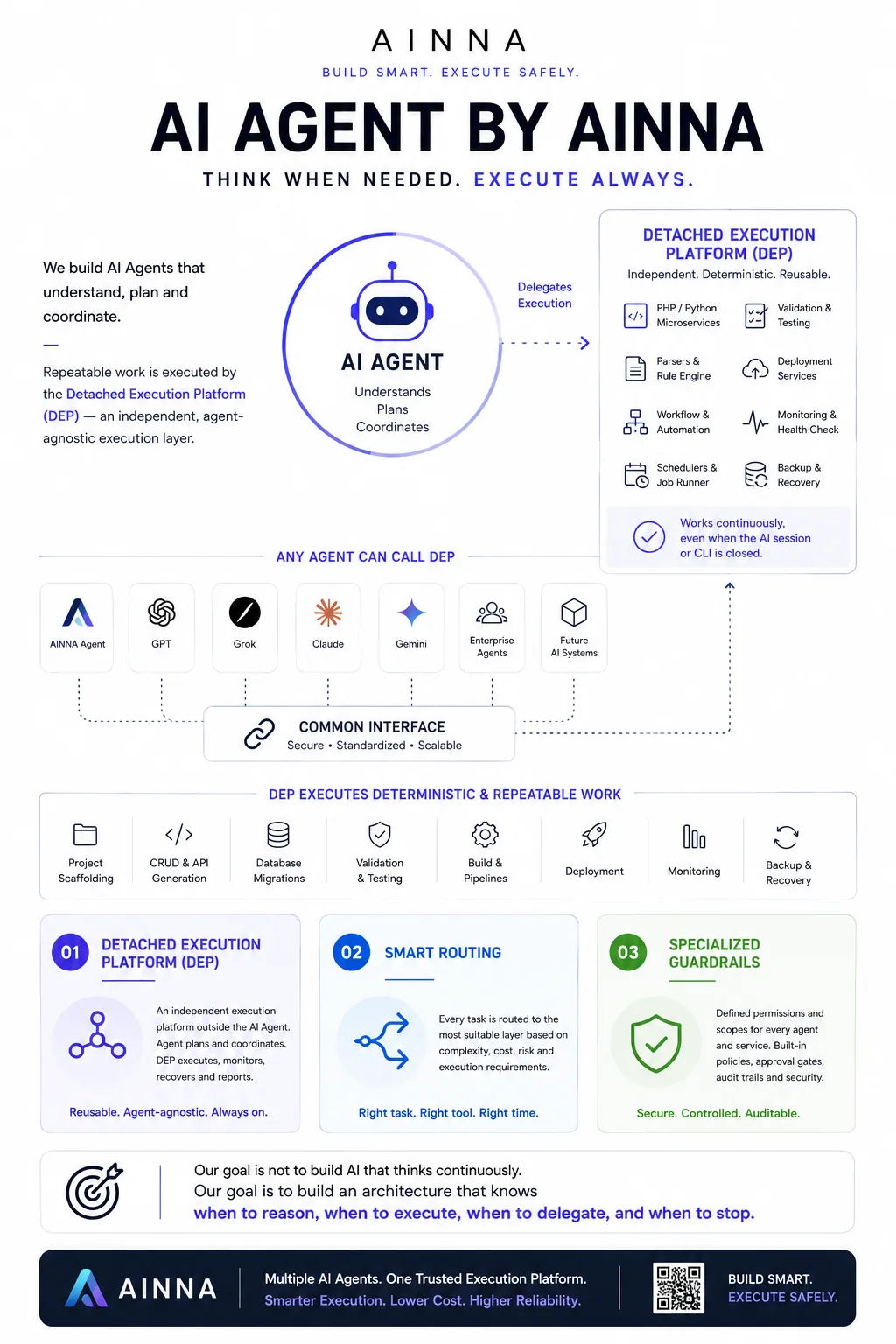
今天, AI 智能体 can take on much of the planning, coding, analysis, testing, debugging, documentation, and decision support. But I do not believe every task belongs in an LLM context window.
In NeuralOps, repetitive and deterministic workloads are pushed into 分离式系统 - conventional 系统 such as PHP services, MySQL, schedulers, parsers, queues, validation engines, and automation scripts.
The AI layer handles the work that actually needs reasoning.
The detached 系统 handles the work that must be consistent, fast, and reliable.
That shift changes the development model in a big way.
Previously:
大 technical team → many specialised functions
Now:
技术 领先 → AI智能体 → 分离式系统
A leaner team can now coordinate functions that used to require an entire development department, while keeping infrastructure cost, token usage, and operational complexity under control.
For me, that is where AI becomes genuinely useful for SMEs.
Not by replacing every 系统 with AI, but by combining human experience, AI reasoning, and reliable conventional infrastructure into one practical architecture.
That is the direction we are engineering with AINNA NeuralOps.
#NeuralOps #AINNA #AgenticAI #AIAutomation #SystemDevelopment #SoftwareArchitecture #SME #DigitalTransformation #AIInfrastructure #自动化