OpenAI is pushing frontier intelligence costs down, and models like DeepSeek are getting surprisingly capable for coding and agentic pipelines.
In the 系统 we build at AINNA, we use OpenAI as a teacher model for distillation.
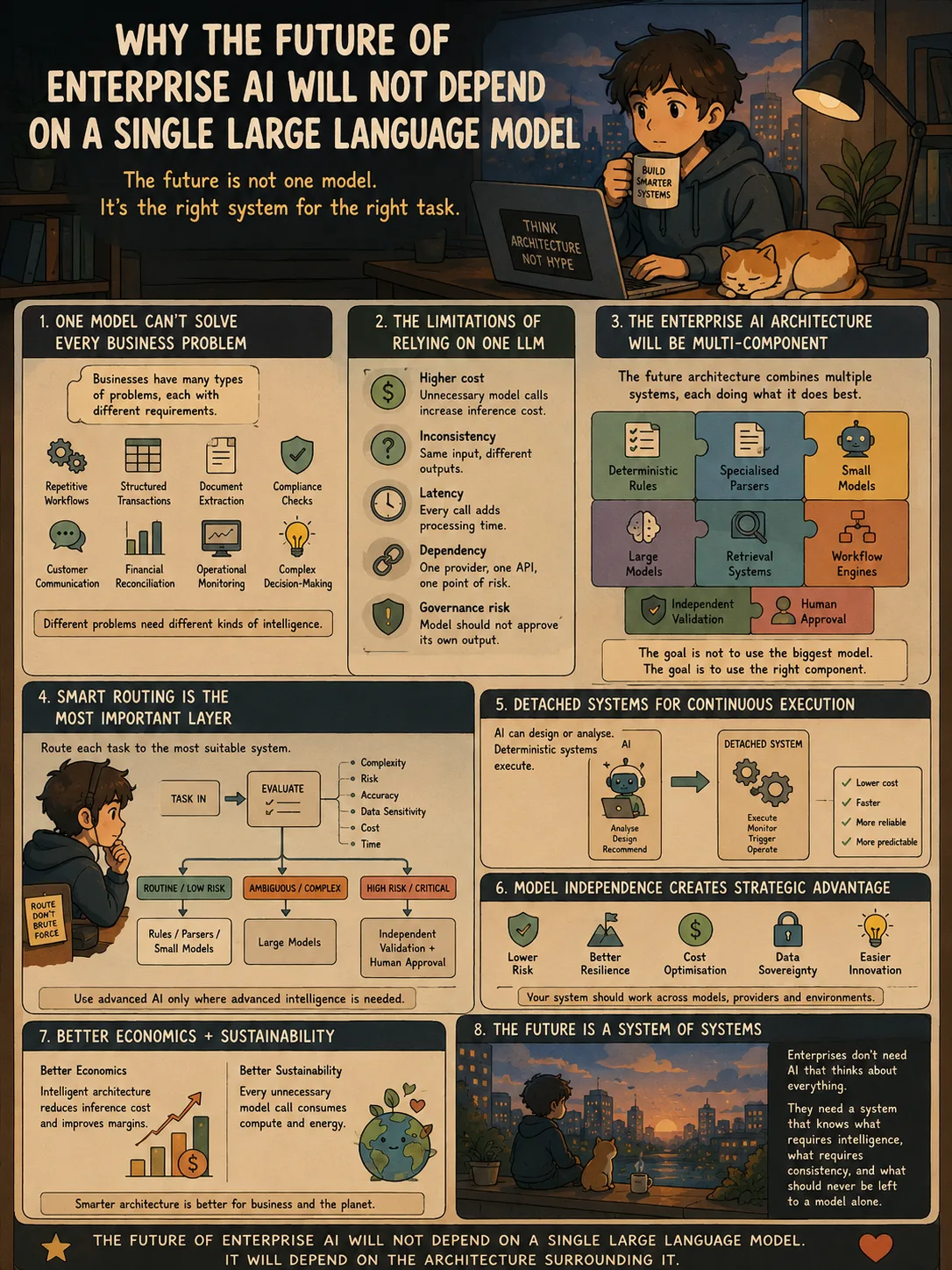
The point is not to route every production request to the most capable model.
We reserve the heavyweights for where their intelligence actually compounds:
训练. 推理. Evaluation. 蒸馏.
然后 we shift repetitive and domain-specific workloads toward smaller efficient models, on-prem or edge models, deterministic services and non-LLM components.
One pattern I keep hitting during field deployments is the difference in token consumption.
Some frontier models burn through context windows on long coding and agentic runs.
With DeepSeek, especially on development-heavy workloads, we have been able to run sizable tasks without constantly bumping into token ceilings.
This raises a practical architecture question:
The best AI model is not the one you should run for every request.
A smarter production stack looks like this:
Advanced OpenAI model → Teacher / 蒸馏
高效 LLM / SLM → Specialised intelligence
独立系统 → Repetitive deterministic workloads
智能路由 → 决定 which layer should handle each task
This is where AI economics starts to matter for builders.
As frontier intelligence gets cheaper, the move is to use it to generate and refine smaller specialised intelligence, instead of paying frontier-model rates on every operation.
For SMEs, that can reshape the cost curve of AI adoption.
The competitive edge will not be owning the biggest API key.
It will be knowing:
which model to use, when to use it, what to distill, and what should not use an LLM at all.
That is the direction we are engineering at AINNA NeuralOps.
#ArtificialIntelligence #AIInfrastructure #OpenAI #DeepSeek #ModelDistillation #AgenticAI #LLM #SLM #AIAgents #SME #NeuralOps