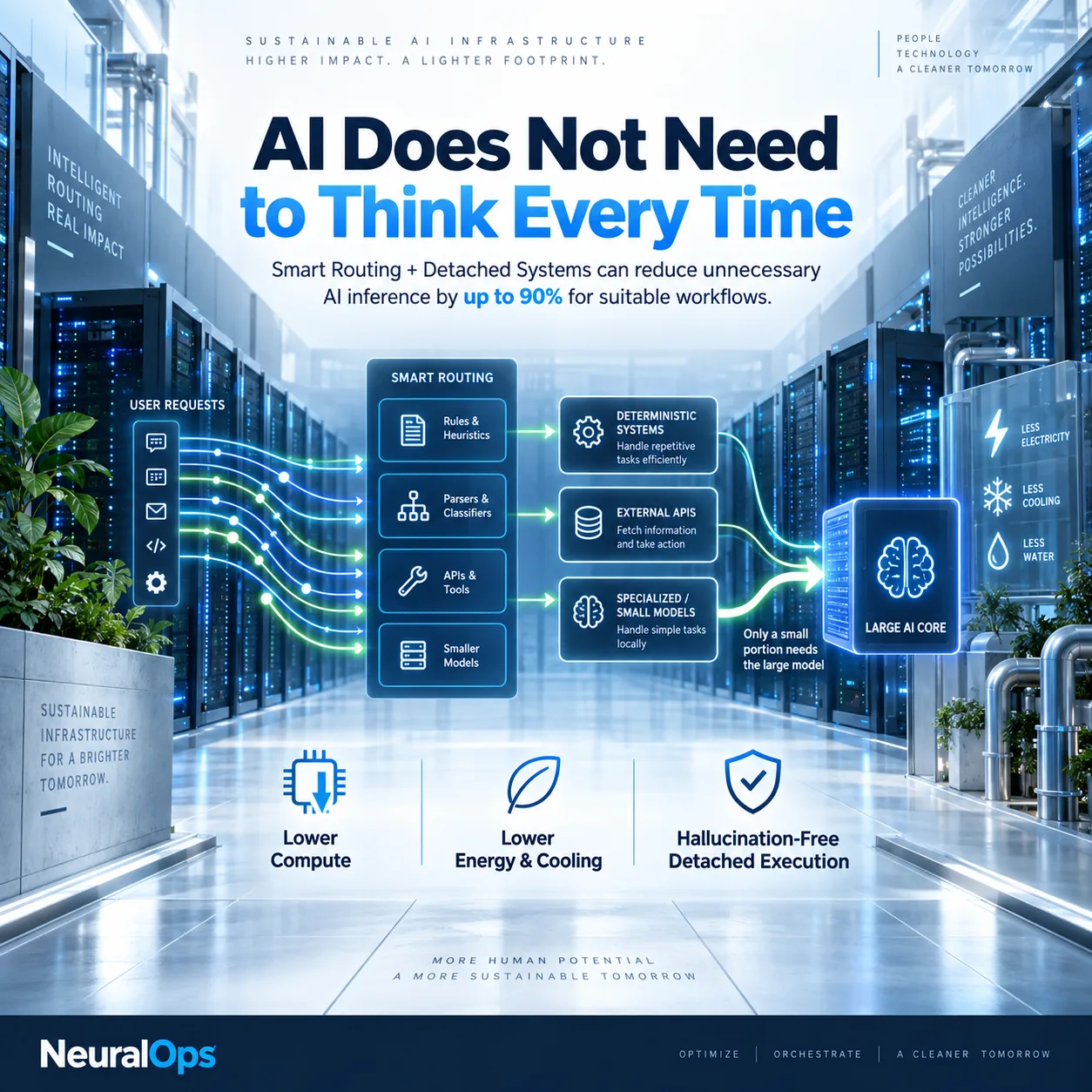
AI infrastructure is growing fast, but there is a financial side we cannot ignore: electricity, cooling and water consumption.
研究 indicates that after deployment, inference can consume as much as 80–90% of an AI model’s total energy. Each avoidable LLM call drives up GPU usage, electricity bills, heat generation, and ultimately cooling expenses-all of which erode profit margins.
That’s why we’re building NeuralOps on a core financial principle:
Not every business operation requires a full LLM.
With 智能路由, we direct tasks to the most cost-effective option-rules, parsers, databases, APIs, or smaller models-before ever escalating to heavy LLM reasoning. Once a process stabilises, we can lock it into a detached deterministic 系统 that runs repeatedly without triggering an LLM call.
For repetitive 工作流 that fit the pattern, this architecture can cut AI inference demand by up to 90%-a direct reduction in compute costs.
The financial impact goes far beyond token costs.
Less inference → Less GPU compute → Less electricity → Less heat → Less cooling → 更低 water demand. That’s a measurable impact on your operating expenses.
可靠性 is another financial benefit.
采用 detached workflow, execution no longer relies on an LLM, which means zero token consumption and zero hallucination risk on that path. We deploy intelligence where reasoning is critical, and deterministic 系统 for repetitive tasks-reducing both operational risk and unexpected cost.
We believe sustainable AI isn’t just about building greener data centres.
It’s also about stopping unnecessary AI inference from ever hitting the data centre-and your electricity bill.
That’s the philosophy behind NeuralOps:
use AI when intelligence is required, and deterministic 系统 when it isn’t.
#Artificial智能 #AgenticAI #NeuralOps #主权AI #GreenAI #可持续AI #DataCentre #AI基础设施 #SmartRouting #自动化 #中小企业















Ruang pembaca
Apa pendapat anda?
Komen disemak sebelum diterbitkan. 电子邮件 diperlukan untuk moderasi dan tidak dipaparkan kepada pembaca.
这篇文章对inference can consume的解释很清楚,实际操作的重点也很容易理解。
看第二遍才注意到研究 indicates that after deployment的细节。
关于which means zero token consumption的说明很完整,基础部分尤其清楚。
关于80的数字比我平时看到的大多数文章靠谱。
简单直接。80就能说明问题。