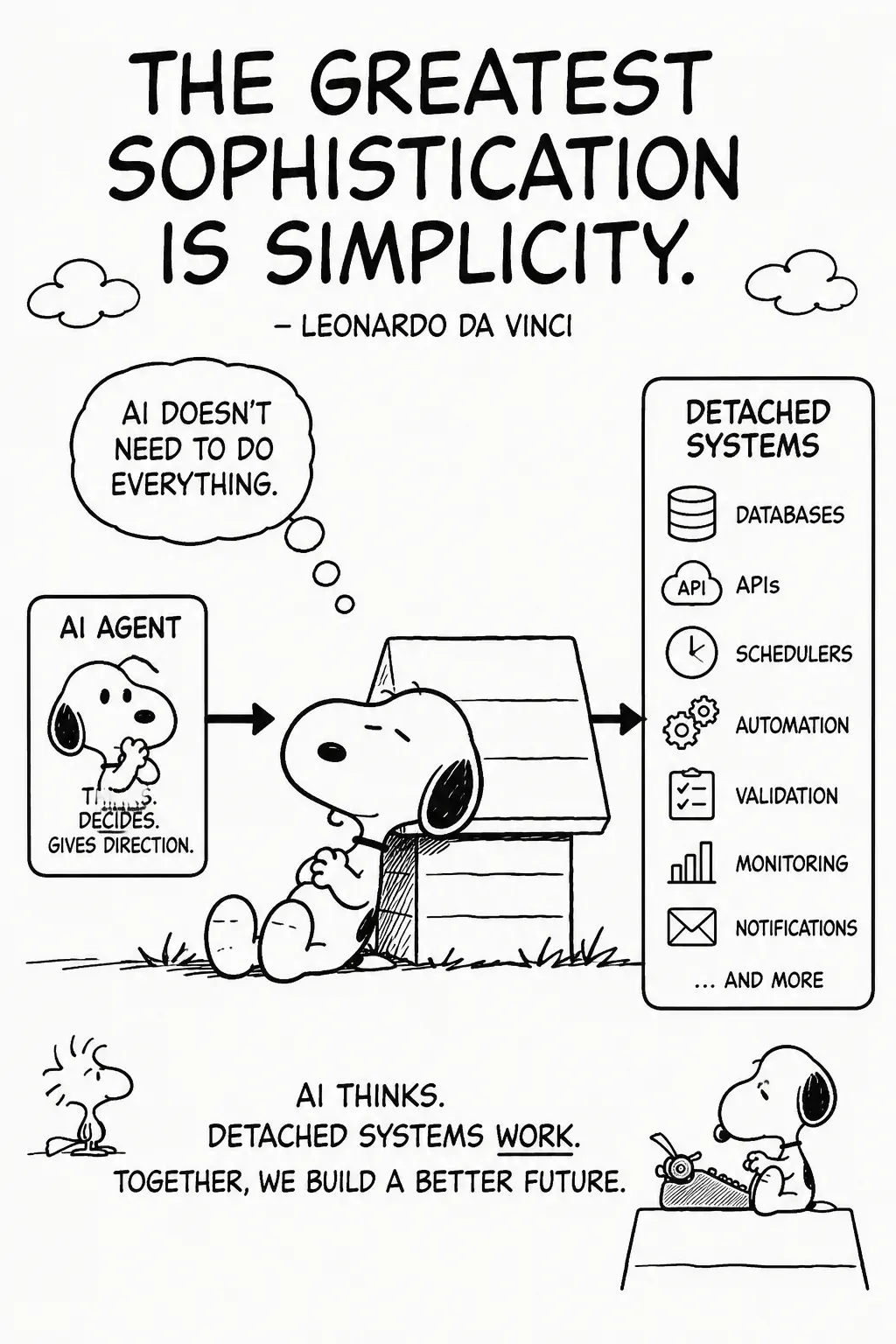
"The greatest sophistication is simplicity." Leonardo da Vinci's observation applies directly to how 马来西亚n 中小企业 should evaluate AI investments today. There is a common assumption that progress means larger models, bigger GPU clusters, and heavier infrastructure spend. 从 a 财务 and accounting perspective, that assumption is risky. The more defensible position is that the highest return on investment comes from architectures that are leaner, more modular, and easier to cost-control.
This is exactly what a 独立系统 offers. It separates the reasoning layer from the execution layer. AI handles decision-making, direction, and complex inference, while existing operational assets-databases, APIs, automation scripts, schedulers, and monitoring 工具-carry out the actual transactions and 工作流. In accounting terms, you are matching the right resource to the right cost category.
At first, this can look counterintuitive. Why deploy AI at all if it is not doing the bulk of the work? The answer is asset utilization. Premium AI compute should be treated as a scarce, higher-cost input and reserved for tasks that genuinely require reasoning. 常规 operational work should sit on lower-cost 系统. It is the same logic that prevents a 财务 leader from processing every supplier invoice personally: the role adds value through oversight and judgment, not through repetitive execution.
For 马来西亚n 中小企业, the business case is clear. A 独立系统 lowers the barrier to adoption because it does not require massive capital expenditure on GPU infrastructure or 企业-grade AI subscriptions. At AINNA, we 设计 this separation so 中小企业 can use AI for 预测ing, planning, and decision support while leaner 系统 handle daily operations. The result is a measurable improvement in productivity without a proportional increase in operating expenditure.
It also improves the sustainability of the technology budget. Every unnecessary AI request carries a direct unit cost in compute and energy. 时间 a deterministic 系统 can complete a task accurately, routing it through an AI model is simply unproductive spend. 分离式系统 help 财务 teams ensure that AI consumption is tied to value creation rather than convenience.
Looking ahead, the companies that extract the most value from AI may not be those that use it everywhere. They will be the ones that allocate AI spend with discipline. True sophistication lies in designing 系统 that are financially clean, operationally transparent, and built to scale without inflating fixed costs. That is why 分离式系统 matter-not only for technology strategy, but for building a more cost-efficient and sustainable 中小企业 business model.















Ruang pembaca
Apa pendapat anda?
Komen disemak sebelum diterbitkan. 电子邮件 diperlukan untuk moderasi dan tidak dipaparkan kepada pembaca.
我特别喜欢routing it through an AI这一部分,内容没有把实施过程说得太简单。
Why deploy AI这个说法我要拿回去跟同事讨论。
文章把true sophistication lies in designing和日常运营联系起来,这一点很有帮助。
如果有更多higher-cost input and reserved的数据和结果会更完整。
总结部分让premium AI compute的重点更加清楚。
难得有人把常规 operational work should sit讲得这么直白。
关于从 a 财务 and accounting的例子很实用,适合团队继续讨论。
文章对分离式系统 help 财务 teams ensure提供了很好的起点,值得继续跟进。