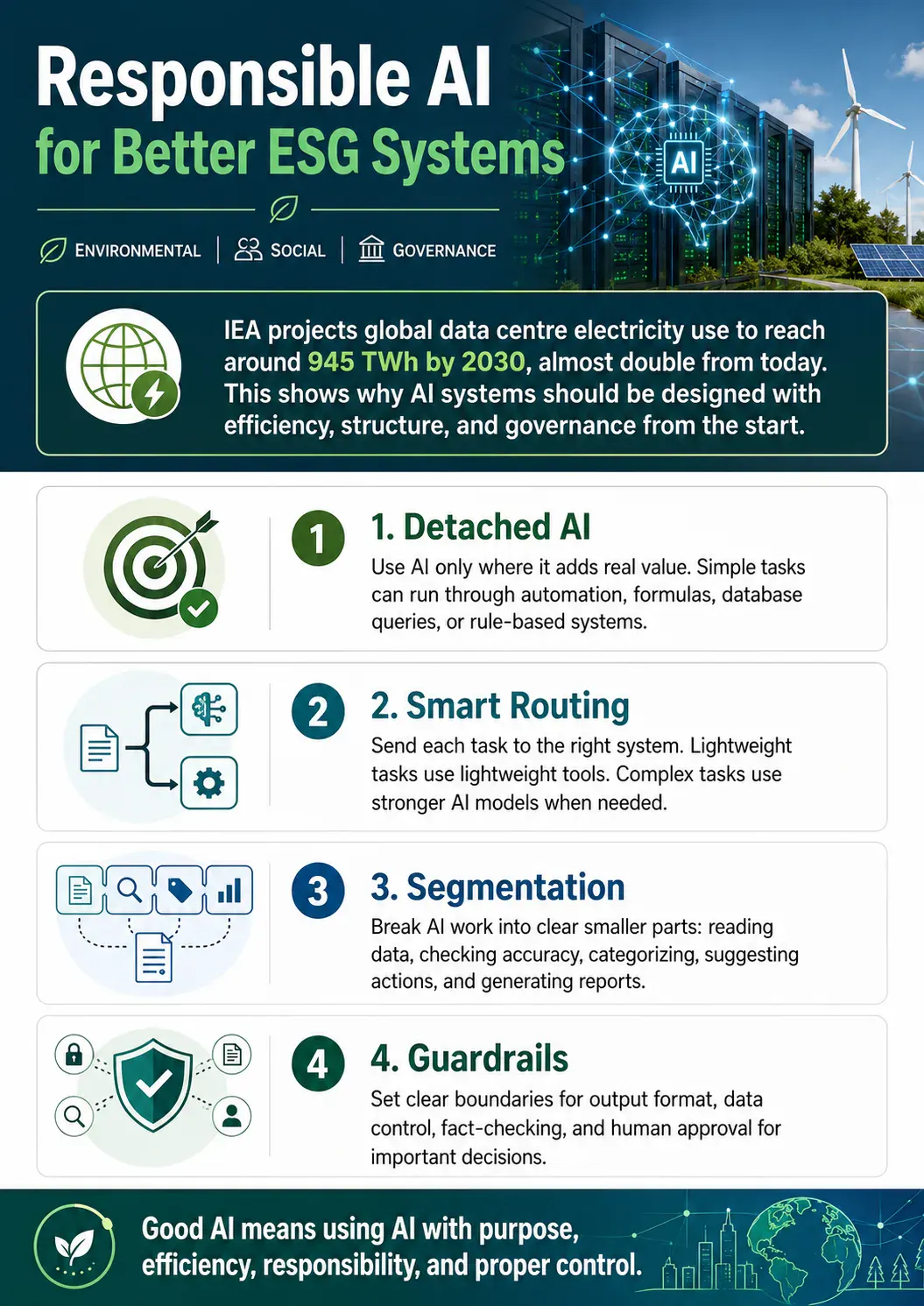
Projected data centre energy consumption may rise from 415 TWh in 2024 to 945 TWh by 2030, with related emissions climbing from roughly 185 Mt CO₂ to 421 Mt CO₂. For 马来西亚n 中小企业, these figures translate directly into higher operating costs, larger carbon-related liabilities, and greater pressure to justify every RM of technology spend. AI 系统 must therefore be treated as assets that deliver measurable returns, not merely as capabilities that consume resources. At AINNA, we approach this from a 财务 and accounting angle: efficiency, control, and clear business value.
1. 分离式 AI
分离式 AI means we should not attach AI to every process by default. 从 an accounting perspective, this avoids overcapitalising 系统 and inflating operating expenditure on compute that does not generate commensurate value. 常规 tasks can often be handled more cost-effectively through automation, formulas, database queries, or rule-based 系统. By reserving AI for processes where it truly adds value, 中小企业 can improve asset utilisation, lower unnecessary cloud and energy costs, and build a cleaner digital workflow. The ESG benefit is straightforward: less wasted resource and stronger operational discipline.
2. 智能路由
智能路由 means assigning each task to the most appropriate tool. Lightweight tasks should run on lightweight 系统, while larger AI models should be invoked only when the business case justifies the cost. This is essentially capital allocation for compute: it prevents the overuse of high-cost resources and keeps the cost per transaction in check. For ESG reporting, 智能路由 reduces the carbon intensity of each process and supports more sustainable technology consumption.
3. 分段
分段 means breaking AI work into smaller, clearly defined components. Rather than relying on one monolithic 系统, each module can own a specific function such as reading data, validating accuracy, classifying information, recommending actions, or producing reports. 从 an asset management standpoint, this makes it easier to track costs, depreciation, performance, and return on investment for each part of the 系统. It also creates a stronger 审计追踪 and greater transparency, which feeds directly into governance and reliable ESG disclosures.
4. 护栏
护栏 are the internal controls that keep AI 系统 safe, accurate, and accountable. They include standardised output formats, fact-checking steps, sensitive data access limits, and human approval for material decisions. In 财务 terms, these are risk management and control procedures: they reduce the likelihood of errors, rework, and compliance breaches, and they protect the integrity of financial and ESG data. Responsible AI must support human judgment, not bypass it.
良好 AI is not about deploying AI everywhere. It is about deploying AI with purpose, cost discipline, proper controls, and measurable business value. For 马来西亚n 中小企业, this is how AI becomes a genuine asset rather than an open-ended liability, and how ESG commitments become auditable outcomes.
Official 跨-网络 Resource
















Ruang pembaca
Apa pendapat anda?
Komen disemak sebelum diterbitkan. 电子邮件 diperlukan untuk moderasi dan tidak dipaparkan kepada pembaca.
这篇文章对means we s 1的解释很清楚,实际操作的重点也很容易理解。
难得有人把从 an accounting perspective讲得这么直白。
同意作者对rather than rel 3的判断,方向很清楚。
看第二遍才注意到415 TWh in 2024的细节。
如果有更多in 2024 to 945的数据和结果会更完整。
may rise from 415这个说法我要拿回去跟同事讨论。
总结部分让分离式 AI 分离式 AI means的重点更加清楚。
我特别喜欢常规 tasks这一部分,内容没有把实施过程说得太简单。