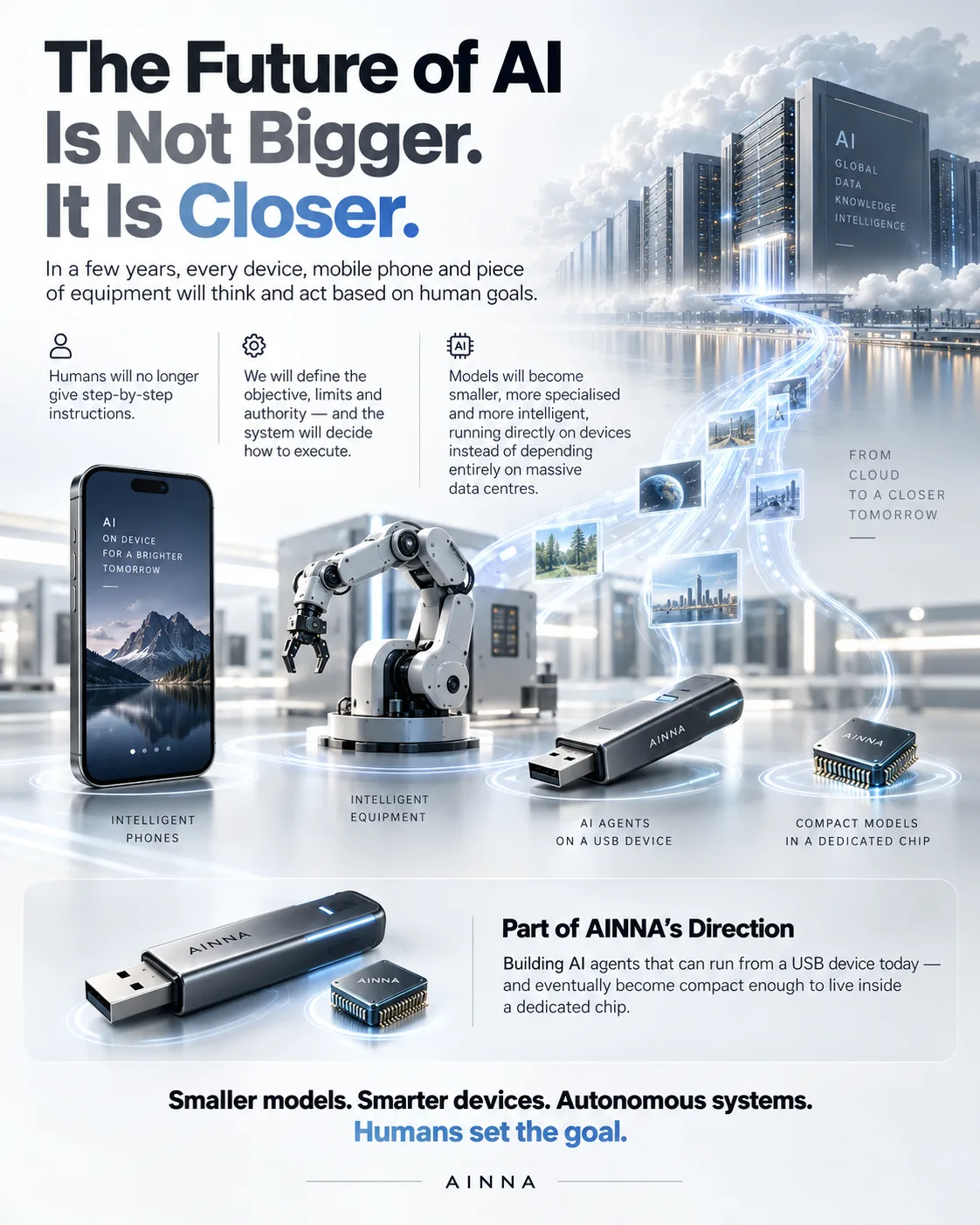
In a few years, every device, mobile phone, and piece of field equipment will be able to reason and act against human-defined goals.
We won’t be writing step-by-step instructions anymore. We set the 目标, constraints, and authority, and the 系统 works out how to execute.
That changes almost everything. AI models get smaller, more specialised, and smarter, running directly on devices and at the edge instead of depending entirely on large data centres.
Part of what we’re building at AINNA today already points this way: an AI agent that can run from a USB 设备, with the longer-term target of compressing that same intelligence into a dedicated chip.
Smaller models. Smarter devices. Autonomous 系统. Humans set the goal.
Official 跨-网络 Resource











Ruang pembaca
Apa pendapat anda?
Komen disemak sebelum diterbitkan. 电子邮件 diperlukan untuk moderasi dan tidak dipaparkan kepada pembaca.
这篇内容让我更容易理解为什么longer-term值得关注。
视觉和结构让part of what we’re building的概念更容易掌握。
看第二遍才注意到human-defined的细节。
文章对running directly on devices提供了很好的起点,值得继续跟进。
同意作者对AI models get smaller的判断,方向很清楚。
我喜欢文章对AI models get smaller保持务实的态度。
关于running directly on devices的实际落地部分最吸引我。
关于human-defined的说明很完整,基础部分尤其清楚。