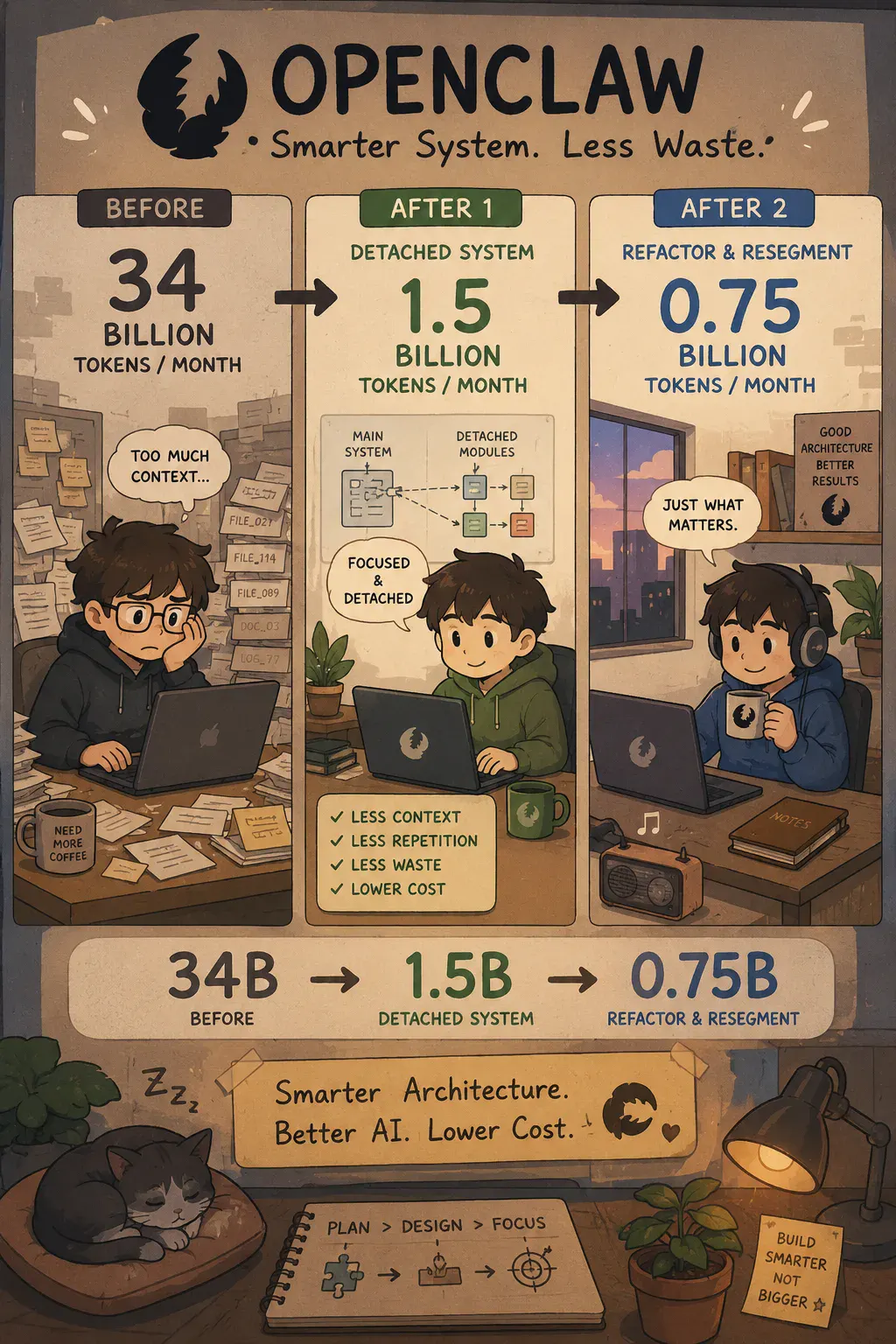
Since deploying OpenClaw at AINNA, our LLM token burn dropped from 34 billion 令牌 per month to 1.5 billion 令牌 per month using the 独立系统 approach.
After adding Refactor and Resegment into the pipeline, we pushed that down further to roughly 750 million 令牌 per month.
The key takeaway from an engineering standpoint: optimization is not always about scaling up GPUs or throwing more compute at the problem. The real gains come from redesigning how the 系统 ingests context, routes tasks, and executes work.
Before this architecture change, the AI had to re-read large amounts of context every time it needed to make a small change. That repeated scanning created wasted 令牌, higher cost, slower execution, and unnecessary load across the pipeline.
With 独立系统, the workload became isolated and focused. With Refactor and Resegment, each process got clear boundaries. The model no longer scans the whole 系统; it operates only on the scoped segment that actually needs attention.
That is how we moved from:
34B → 1.5B → 750M 令牌/月
Less context.
Less repetition.
Less waste.
更低 cost.
更快的执行.
从 a 系统-integration perspective, this confirms what we see in the field: the future of AI efficiency is not just stronger hardware. It is about smarter architecture, cleaner context management, and modular execution pipelines.
效率 starts with 系统 设计.
#OpenClaw #AI #LLM #AIAgents #SystemArchitecture #TokenOptimization #SoftwareEngineering #AIEngineering #效率