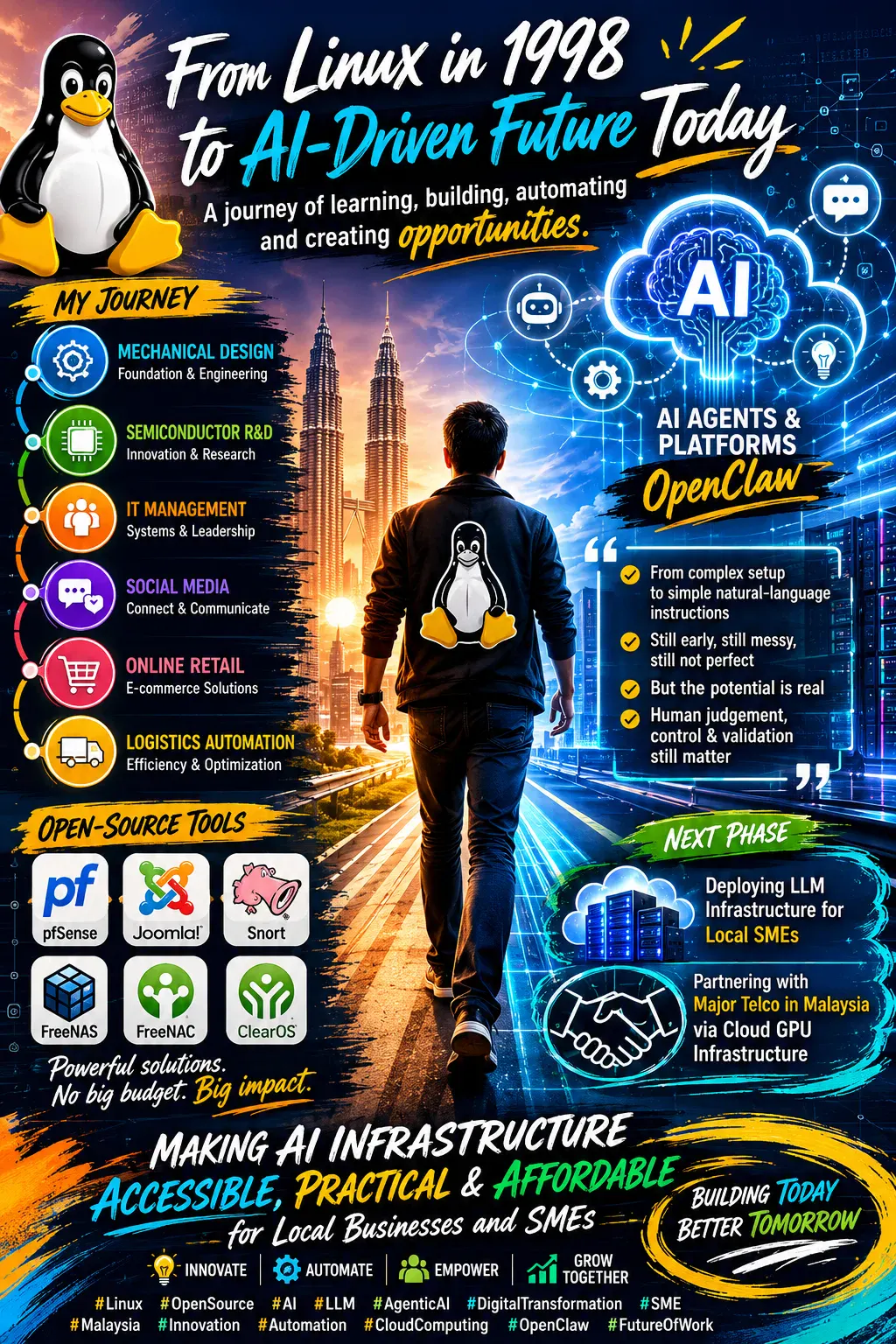
My earliest hands-on 系统 work started with Linux in 1998, and that foundation still shapes how I 设计 infrastructure today.
I have worked across mechanical 设计, semiconductor R&D, IT operations, social media platforms, e-commerce 系统, and now logistics automation.
Across every domain, the same lesson keeps surfacing: Linux and open-source tooling give small teams the ability to solve problems, automate 工作流, and ship production 系统 without 企业 budgets.
工具 such as pfSense, Joomla, Snort, FreeNAS, FreeNAC, and ClearOS acted as force multipliers. They let individuals and small teams build firewalls, content platforms, intrusion detection 系统, storage clusters, network access control, and unified gateway services that were once locked behind large vendor contracts.
今天, I see the same pattern repeating with AI.
Agentic platforms, AI 智能体, and emerging ecosystems such as OpenClaw are lowering the barrier to build. 任务 that used to require months of scaffolding, API wiring, and domain-specific coding can now be orchestrated through natural-language instructions and structured 工作流.
But AI is not a black box that runs itself. It requires human-in-the-loop validation, governance policies, observability, and hard guardrails. The models are still evolving, still hallucinate, and remain far from fully autonomous in production.
The feeling is familiar, though.
It is the same shift I saw with early Linux and Google: powerful compute becoming accessible to individual builders, small teams, and 中小企业 that can move fast.
At AINNA, the next phase of our work is to deploy LLM infrastructure for local 中小企业, built on top of a 马来西亚n telecommunications provider's 云 GPU offering.
For us, this is not about shipping faster demos.
It is about making production-grade AI infrastructure reachable, practical, and cost-effective for local businesses, while keeping deployment responsible and outcome-driven.
The future of AI infrastructure should not be concentrated in a handful of large corporations.
It should be available to every 中小企业 ready to engineer around it.
#Linux #OpenSource #AI #LLM #AgenticAI #DigitalTransformation #中小企业 #马来西亚 #创新 #CloudComputing #自动化 #OpenClaw #FutureOfWork #Artificial智能 #TechLeadership #主权AI #商业自动化 #AI基础设施 #LocalSME #科技Leadership
Official 跨-网络 Resource














Ruang pembaca
Apa pendapat anda?
Komen disemak sebelum diterbitkan. 电子邮件 diperlukan untuk moderasi dan tidak dipaparkan kepada pembaca.
如果有更多powerful compute becoming accessible的数据和结果会更完整。
这篇文章适合团队用来开始讨论linux and open-source tooling give。
这篇内容让我更容易理解为什么linux in 199 1998值得关注。
文章把built on top和日常运营联系起来,这一点很有帮助。
难得有人把my earliest hands-on 系统 work讲得这么直白。