
SMART CITY COST LEDGER: DIRECT AI VS NEURALOPS
For a chief financial officer or asset 经理, a city of 1 million people represents a large operating entity that may emit approximately 8.3 million tonnes of CO₂e annually.
If smarter management of traffic, energy, water, waste, buildings, and infrastructure trims that footprint by just 6%, the municipality avoids around:
498,000 tonnes of CO₂e per yearThat is equivalent to roughly:
46 天数 of emissions from one average coal-fired power plantThe real question is therefore not whether a city has deployed AI.
It is how efficiently its AI budget and compute assets are used.
The direct-AI cost profile
Every task-simple check, alert, calculation, or routine workflow-is sent to the largest available AI model.
This inflates the operating statement and the carbon ledger:
❌ Higher token consumption
❌ Longer GPU utilisation
❌ Higher electricity demand
❌ Higher data-centre and cooling costs
❌ A larger AI-related carbon exposure
The NeuralOps value proposition
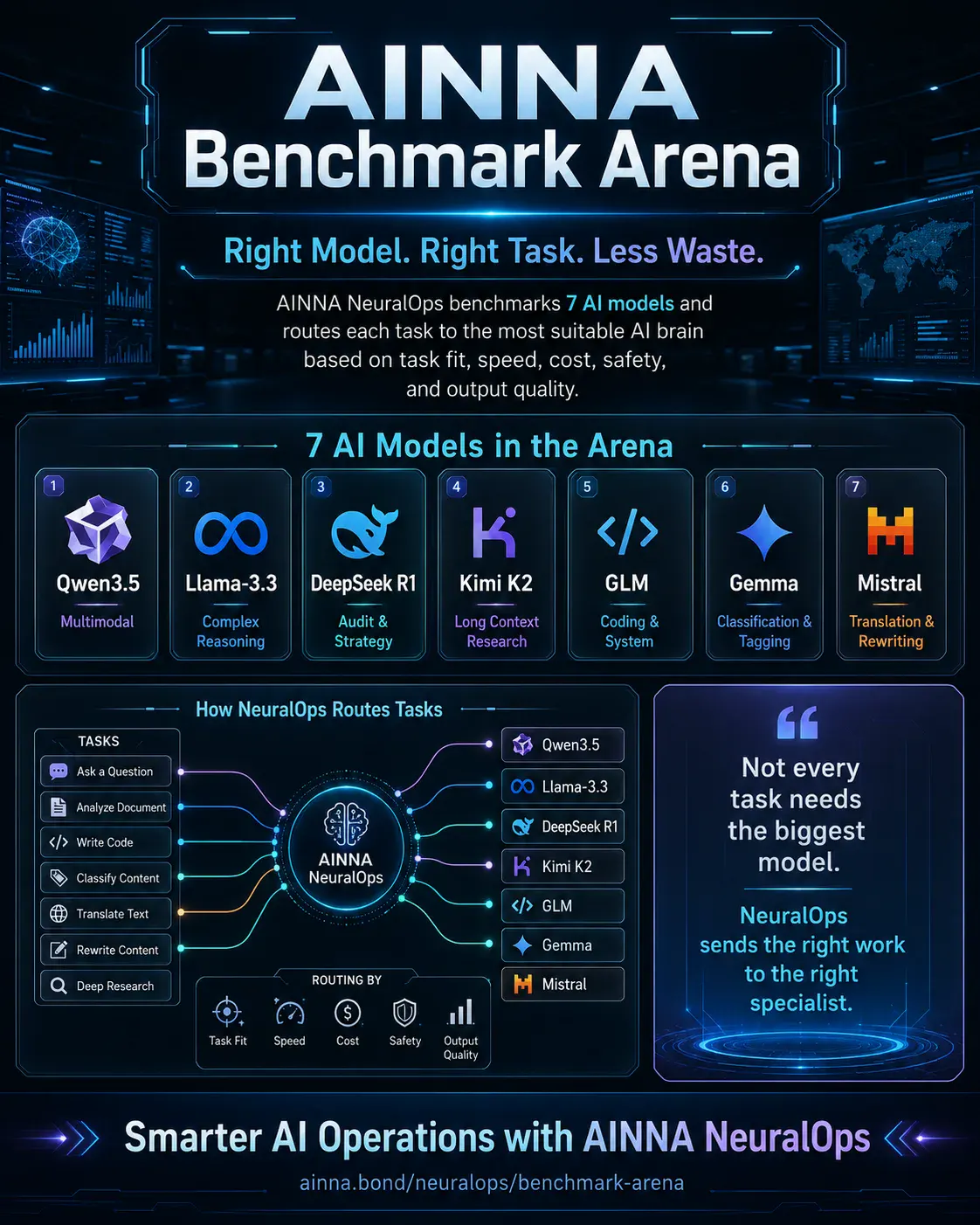
NeuralOps treats inference as an asset-allocation problem. It combines:
✅ 智能路由
✅ 分离式系统
✅ 模型 分段
✅ 专业化 AI智能体
✅ 确定性验证
✅ 小型模型s for simple tasks
✅ 大型模型s reserved for 复杂决策
Inside AINNA’s own operations, estimated workload fell from approximately 32 billion 令牌 to 2–3 billion 令牌.
That is a 90.6%–93.8% reduction in computational workload.
碳 emissions do not fall in lockstep, but the financial and environmental impact is material: lower inference spend, fewer GPU hours, reduced electricity and cooling bills, and lighter carbon-reporting exposure.
The IPCC has noted:
“An increasing share of emissions can be attributed to urban areas.”
A 智慧城市 should not be measured by the volume of AI it deploys.
It should be measured by the waste, cost, energy use, and carbon it removes per ringgit of public or private investment, and the same capital-efficiency discipline is what lets 马来西亚n 中小企业 protect margins, extend hardware life, and lower ESG compliance costs.
Direct AI asks:
Which model should answer this?
NeuralOps asks:
Does this task require AI at all?
And when it does:
What is the smallest, most cost-efficient model capable of completing it accurately?
Less computation.
Better capital allocation.
更低 operating expenditure.
更低 emissions exposure.
#NeuralOps #AINNA #智慧城市 #GreenAI #成本效率 #Capex优化 #OPEX #碳会计 #ESG #资产管理
















Ruang pembaca
Apa pendapat anda?
Komen disemak sebelum diterbitkan. 电子邮件 diperlukan untuk moderasi dan tidak dipaparkan kepada pembaca.
关于46 天数 of emissions的实际落地部分最吸引我。
这篇文章对of 1 m 1 million的解释很清楚,实际操作的重点也很容易理解。
关于estimated workload fell的例子很实用,适合团队继续讨论。