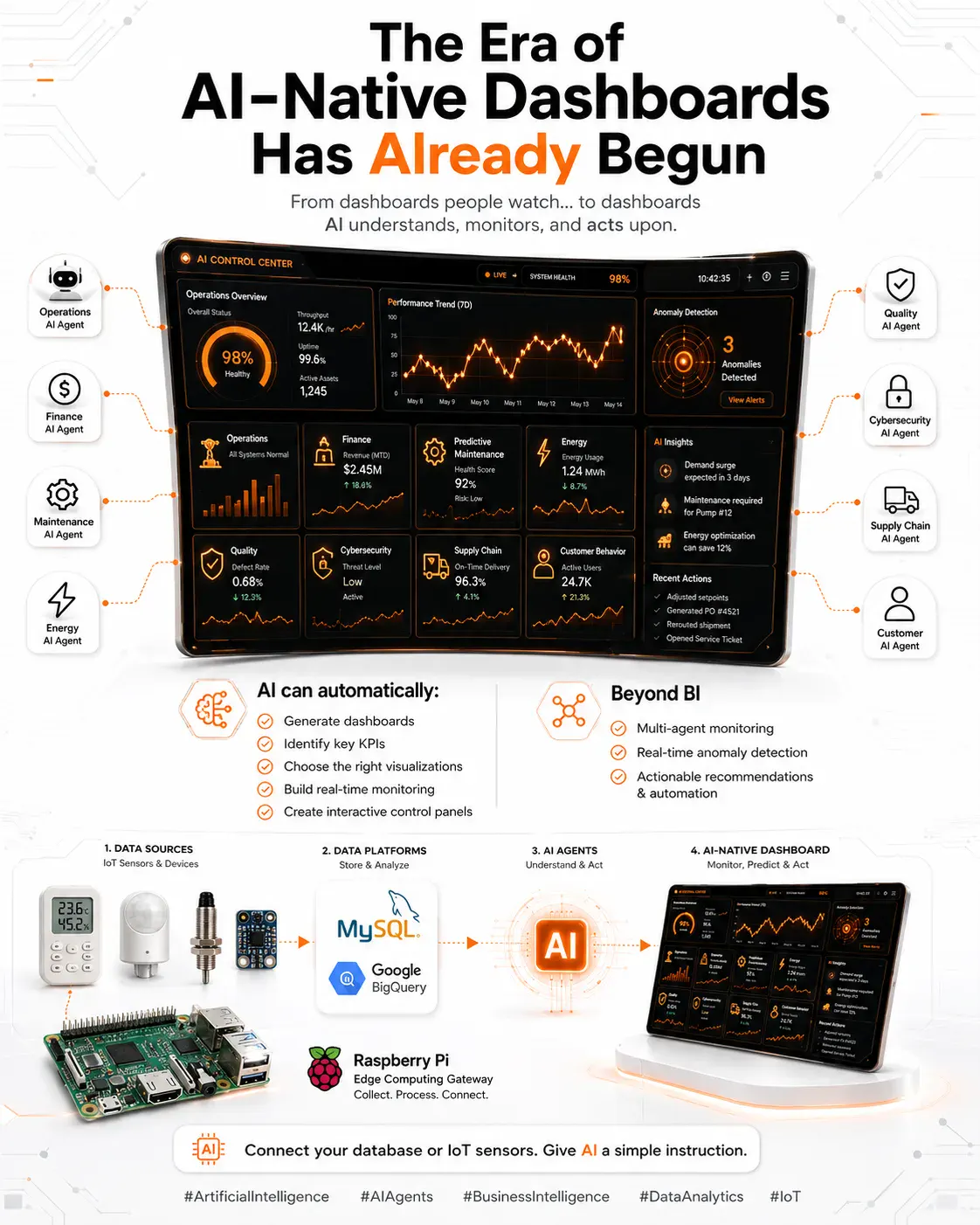
Two years ago, 中小企业 were often judged by how fast 财务 teams could produce management reports in spreadsheets or standard BI 工具. Those skills still matter, but at AINNA we see the real shift in the cost and speed of turning operational data into business insight.
今天, once your accounting 系统, inventory ledger, or IoT-enabled assets are connected, one carefully written prompt can do work that used to take 天数 of manual consolidation.
AI can automatically:
Generate management dashboards and 损益表 views.
Identify the KPI that affect cash flow, margins, and asset utilization.
Select visualizations that 财务 and operations teams can act on quickly.
构建 real-time monitoring for receivables, payables, and fixed-asset performance.
创建 control panels tailored to 中小企业 accounting and asset-management 工作流.
But that is only the efficiency gain.
想象 not having one AI reading your reports, but ten 财务 and operations agents working in parallel.
One agent monitors cash flow and working capital. Another tracks fixed-asset depreciation and maintenance schedules. Others watch inventory turnover, 天数 sales outstanding, tax compliance, supplier payments, cost variances, and customer profitability. Each agent can use the AI model best suited to its domain.
Instead of simply displaying charts, these agents continuously reconcile transactions, detect anomalies, spot margin trends, generate insights, recommend collection or payment actions, and-where policies and approvals allow-even automate journal entries or scheduling.
The part that matters to 财务?
These dashboards no longer have to 实时 in separate BI subscriptions that many 中小企业 find hard to justify.
They can be embedded directly into your accounting/ERP platform, asset register, or internal portals-giving 马来西亚n 中小企业 stronger data control, clearer 审计追踪s, better reliability, and a user experience 财务 teams will actually adopt.
We are moving from reports that 财务 teams build manually each month...
...to dashboards that understand 中小企业 operations, monitor financial health, and trigger the next action.
The future of 中小企业 analytics is not just about visualization.
It is about intelligent 系统 that observe transactions, reason through variances, and help 财务 and operations teams make faster, defensible decisions.
And it starts by connecting your accounting, inventory, and asset data-and giving the AI a clear, 财务-led instruction.
The era of AI-native financial operations has already begun.
#Artificial智能 #AIAgents #商业智能 #数据分析 #IoT #DigitalTransformation #自动化 #行业40 #SmartSystems #创新













Ruang pembaca
Apa pendapat anda?
Komen disemak sebelum diterbitkan. 电子邮件 diperlukan untuk moderasi dan tidak dipaparkan kepada pembaca.
同意作者对创建 control panels tailored的判断,方向很清楚。
这篇文章对select visualizations that 财务的解释很清楚,实际操作的重点也很容易理解。
关于identify the KPI that affect的实际落地部分最吸引我。
文章对构建 real-time monitoring for receivables的结论比较平衡,不只是强调好处。
文章对select visualizations that 财务提供了很好的起点,值得继续跟进。
还在消化这篇文章这一段。