Two decades ago, technology vendors told 马来西亚n businesses that IPv6 would become mainstream within one or two years.
The technology was ready. The return on investment for most 中小企业 was not.
At the time, IoT remained a pilot-level cost centre, 边缘 AI had no clear payback, and there was little justification for assigning a unique IP address to every forklift, sensor or household appliance. IPv6 therefore advanced at the pace of balance-sheet approval, not vendor enthusiasm.
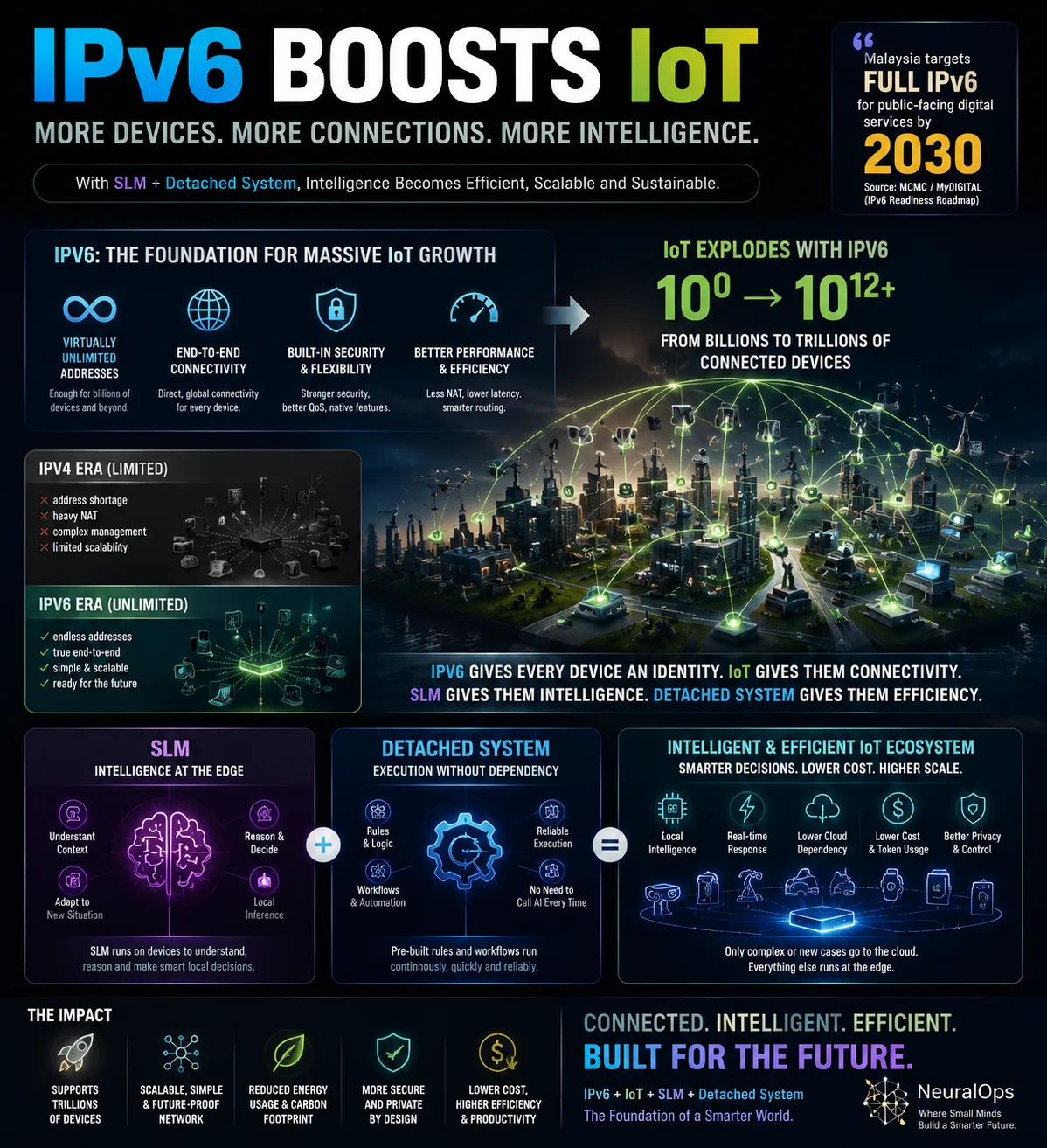
Fast forward to today. 马来西亚 is now moving towards full IPv6 adoption, with a proposed national direction for complete migration by 2030.
The real balance-sheet opportunity, however, is not IPv6 alone. It is the convergence of IPv6, IoT, 小 语言 Models and 分离式系统.
An SLM can act as the local exception-handling layer. It reads context, identifies unfamiliar patterns and recommends the correct action. The 独立系统 then becomes the fixed-execution layer, running validated rules, algorithms and 工作流 continuously without repeatedly paying for an AI inference call.
This separation changes the unit economics of 边缘 AI.
The SLM does not need to control every routine action. It is activated only when reasoning, adaptation or exception handling is required. Once the correct logic has been established, the 独立系统 carries out the repetitive work reliably and at a much lower compute cost.
IPv6 gives each asset a stable identity. IoT provides the telemetry. SLMs provide local decision support. 分离式系统 provide efficient and repeatable execution. Peer-to-peer networking allows devices to collaborate without unnecessary cloud hops.
For a 马来西亚n 中小企业, a smart cup, factory sensor, vehicle component or household appliance could therefore resolve most routine events locally. Only unfamiliar or high-impact cases would need to be escalated to a larger model or cloud GPU infrastructure.
This architecture can materially reduce cloud workload, GPU 依赖, token consumption, bandwidth, latency and total cost of ownership.
The future of AI is unlikely to be one giant, centralised capex-heavy brain inside a data centre.
It is more likely to be millions of small capital assets, each with its own IPv6 address, combining an SLM with a 独立系统 and working together through a distributed peer-to-peer network.
云 infrastructure will remain important for model training, large-scale coordination and genuinely complex workloads. But everyday intelligence and execution can increasingly be amortised across edge devices.
At AINNA, we view what appeared to be a networking upgrade twenty years ago as one of the foundations of distributed, capital-efficient intelligence for the 马来西亚n 中小企业 we support.
#IPv6 #SLM #小语言Models #分离式系统 #EdgeAI #IoT #分配dAI #PeerToPeer #Artificial智能 #NeuralOps














Ruang pembaca
Apa pendapat anda?
Komen disemak sebelum diterbitkan. 电子邮件 diperlukan untuk moderasi dan tidak dipaparkan kepada pembaca.
这篇内容让我更容易理解为什么ioT provides the telemetry值得关注。
如果有更多identifies unfamiliar patterns and recommends的数据和结果会更完整。
看第二遍才注意到sensor or household appliance的细节。
Models and 分离式系 6这个说法我要拿回去跟同事讨论。