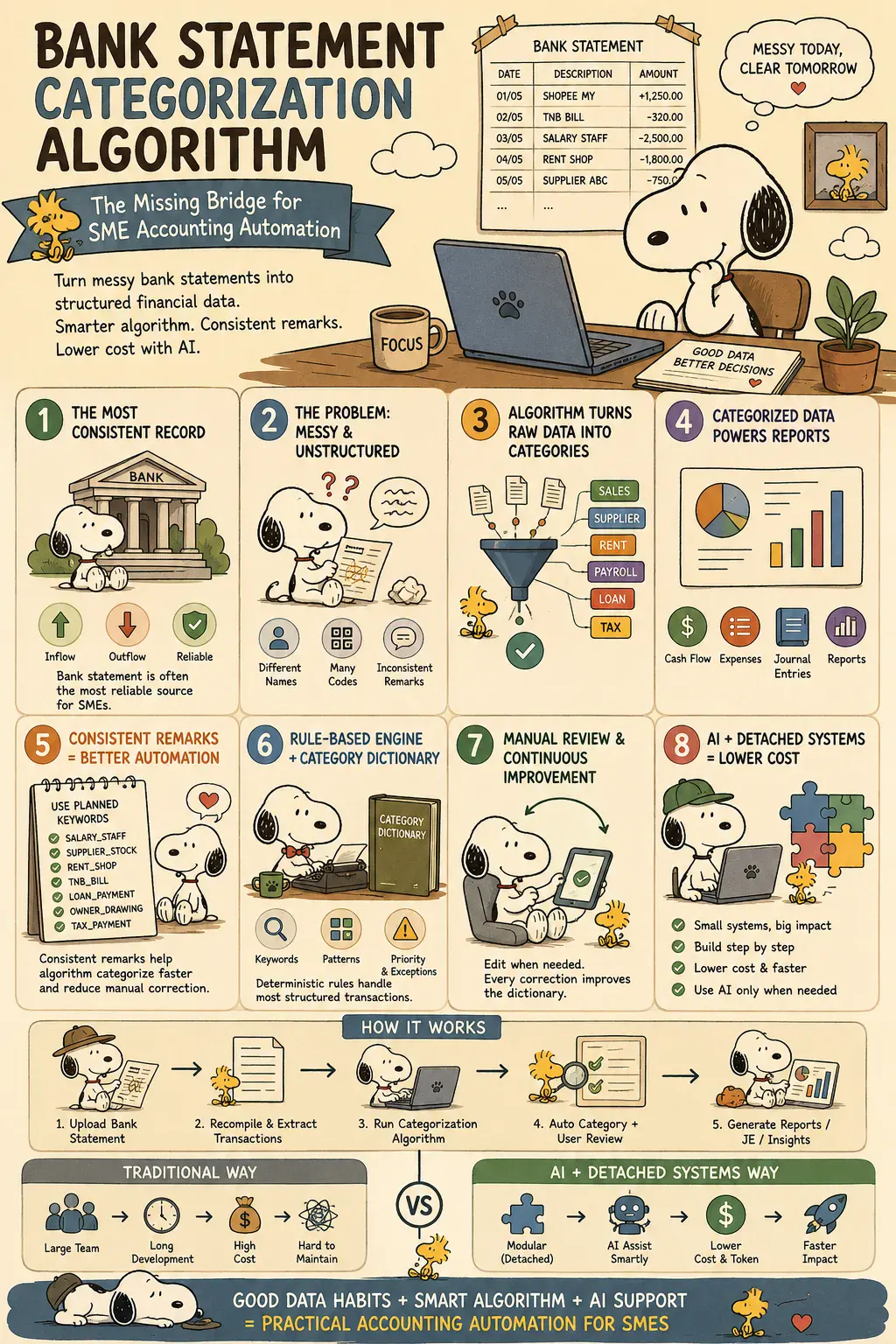
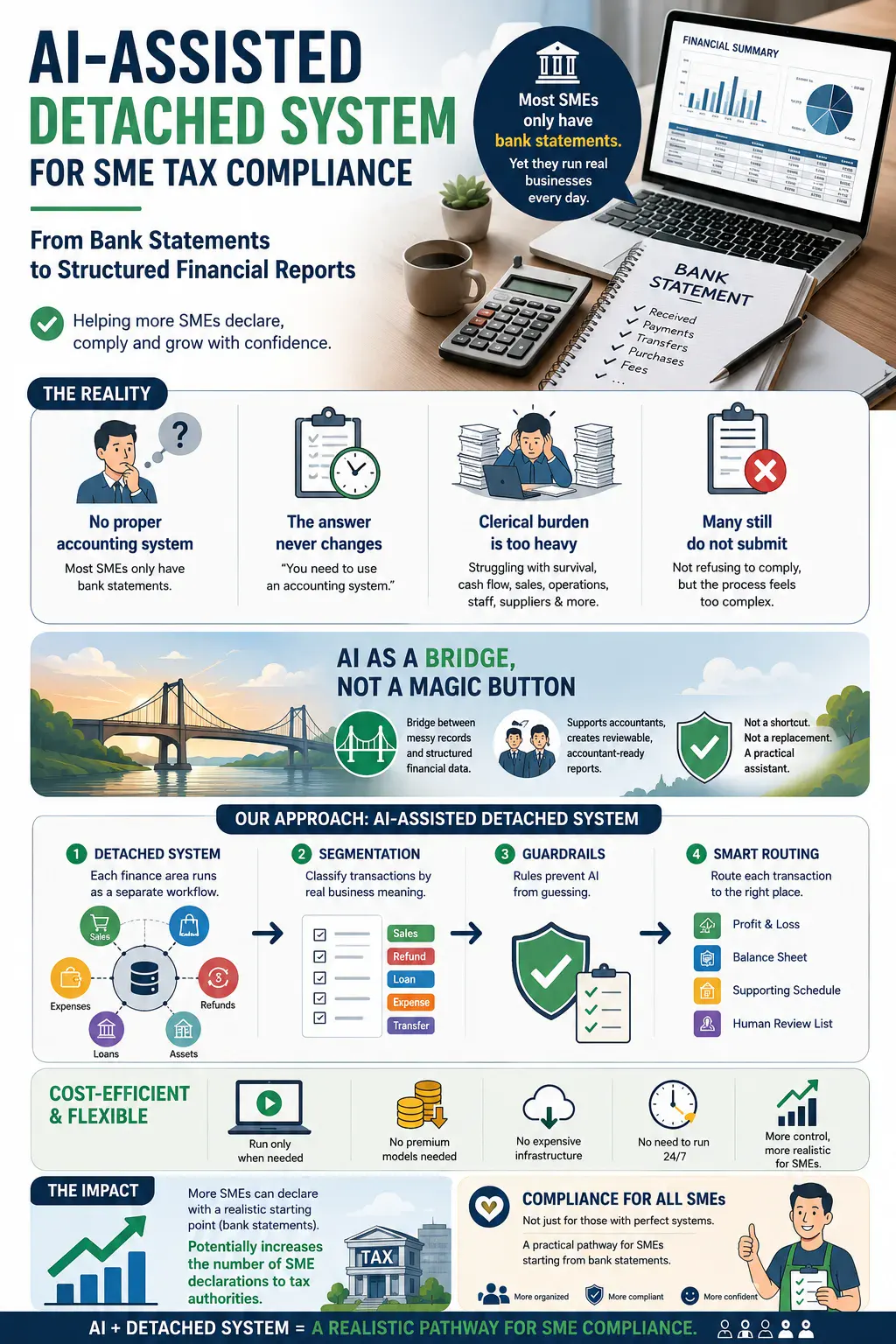
从 an accounting operations standpoint, the bank statement is often the single source of truth 面向马来西亚中小企业. 销售 ledgers may be informal, invoices may not always be issued, and bookkeeping updates can fall behind day-to-day trading. Yet every cash movement-whether revenue, supplier payment, or owner withdrawal-still leaves a trace in the bank account.
This makes bank statement automation a high-impact starting point for 中小企业 accounting transformation. The challenge is not the lack of data. It is the lack of structure. Transaction descriptions blend merchant names, reference numbers, payment gateway codes, QR references, bank identifiers, inter-account transfers, and inconsistent user remarks. Standard accounting 工作流 struggle to turn this into reliable ledger entries.
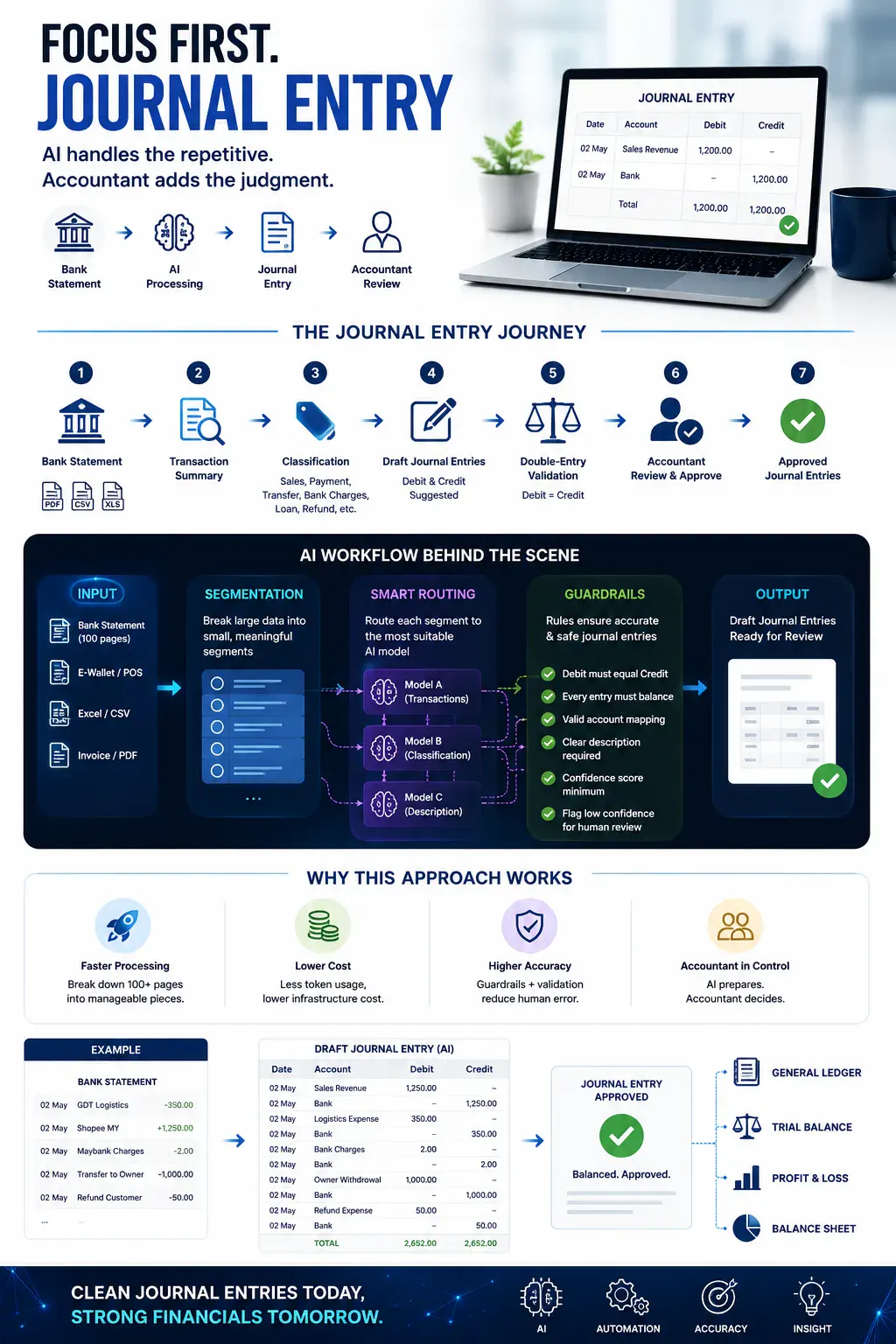
A structured 银行 Statement Categorization Algorithm solves this by mapping each transaction to predefined accounts: sales revenue, supplier payments, rental expenses, payroll, utilities, loan repayments, tax remittances, owner drawings, marketplace settlements, refunds, and bank charges. Once classified, the same dataset supports cash position summaries, expense analysis, draft journal entries, and management reports.
A bank statement should not stop at being a monthly PDF for filing. It should become a structured feed into the general ledger.
自动化, however, only works when transaction behavior supports it. 中小企业 can reduce reconciliation time by adopting consistent transaction remarks. Rather than vague descriptions such as “payment,” “transfer,” or “settle,” businesses should standardise on meaningful keywords such as SALARY_STAFF, SUPPLIER_STOCK, RENT_SHOP, TNB_BILL, LOAN_PAYMENT, OWNER_DRAWING, and TAX_PAYMENT.
This discipline directly affects the quality of financial reporting. Consistent remarks improve categorisation accuracy, reduce manual adjustment entries, and shorten the month-end close. 清理 outputs require clean inputs.
The right architecture is hybrid, not purely AI-driven. A deterministic rule-based engine with a 类别 Dictionary should handle high-volume, repetitive transactions, while AI is reserved for exceptions where the description is ambiguous or incomplete. This approach gives 财务 teams a clear 审计追踪 and controlled automation.
Modern AI has also made modular financial 系统 more accessible to 中小企业. Instead of replacing an entire accounting platform, businesses can implement focused components: a statement reader, a categorisation module, a summary generator, and a journal entry preparer. That is how AINNA helps bridge the gap between informal 中小企业 record-keeping and disciplined accounting automation-one controlled financial workflow at a time.














Ruang pembaca
Apa pendapat anda?
Komen disemak sebelum diterbitkan. 电子邮件 diperlukan untuk moderasi dan tidak dipaparkan kepada pembaca.
Transaction descriptions blend merchant names这个说法我要拿回去跟同事讨论。
收藏了,主要是为了从 an accounting operations standpoint。
这篇文章适合团队用来开始讨论once classified。
文章把standard accounting 工作流 struggle和日常运营联系起来,这一点很有帮助。
关于yet every cash movement-whether revenue的说明很完整,基础部分尤其清楚。
如果可以继续说明中小企业 can reduce reconciliation time的真实案例,我会想继续阅读。