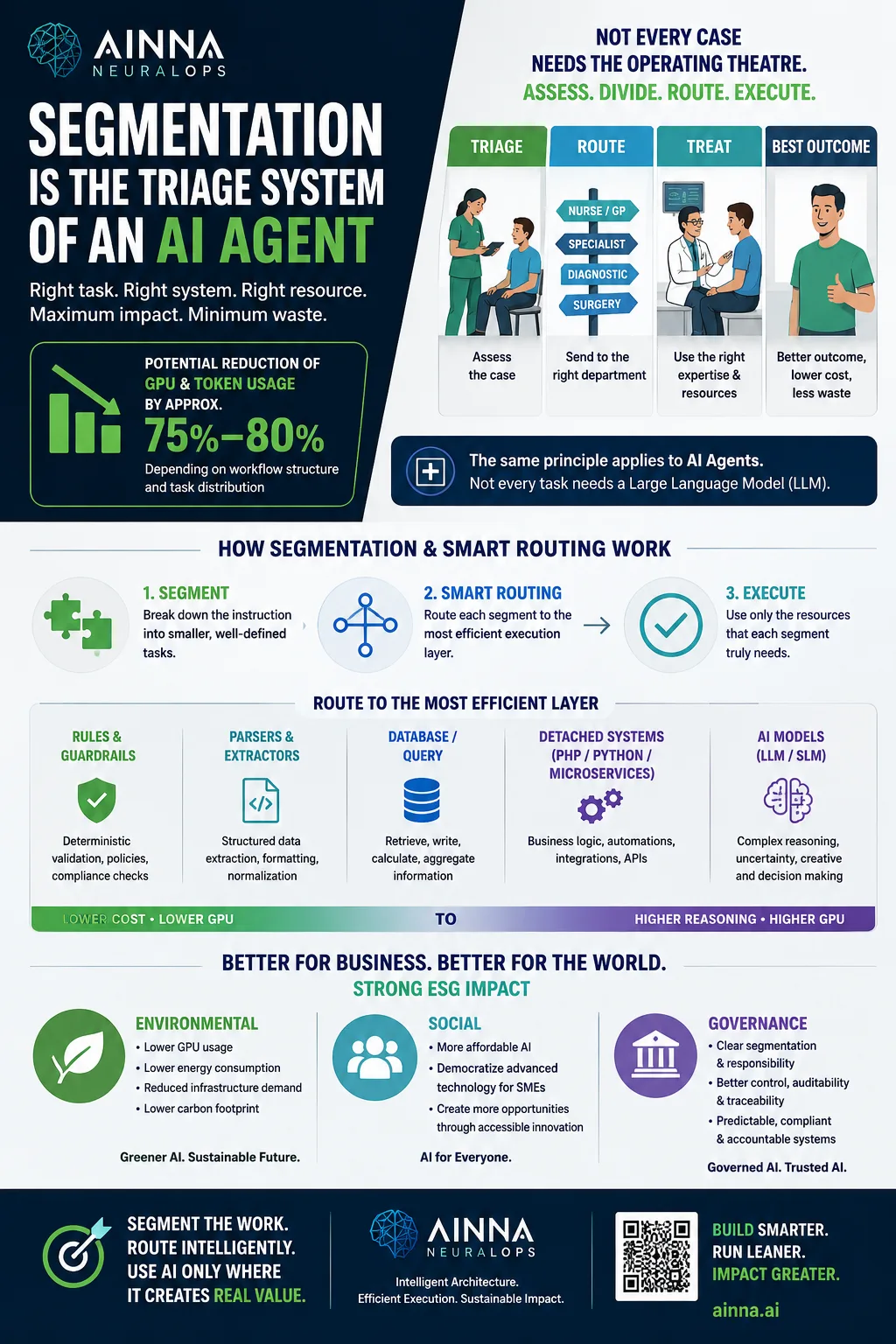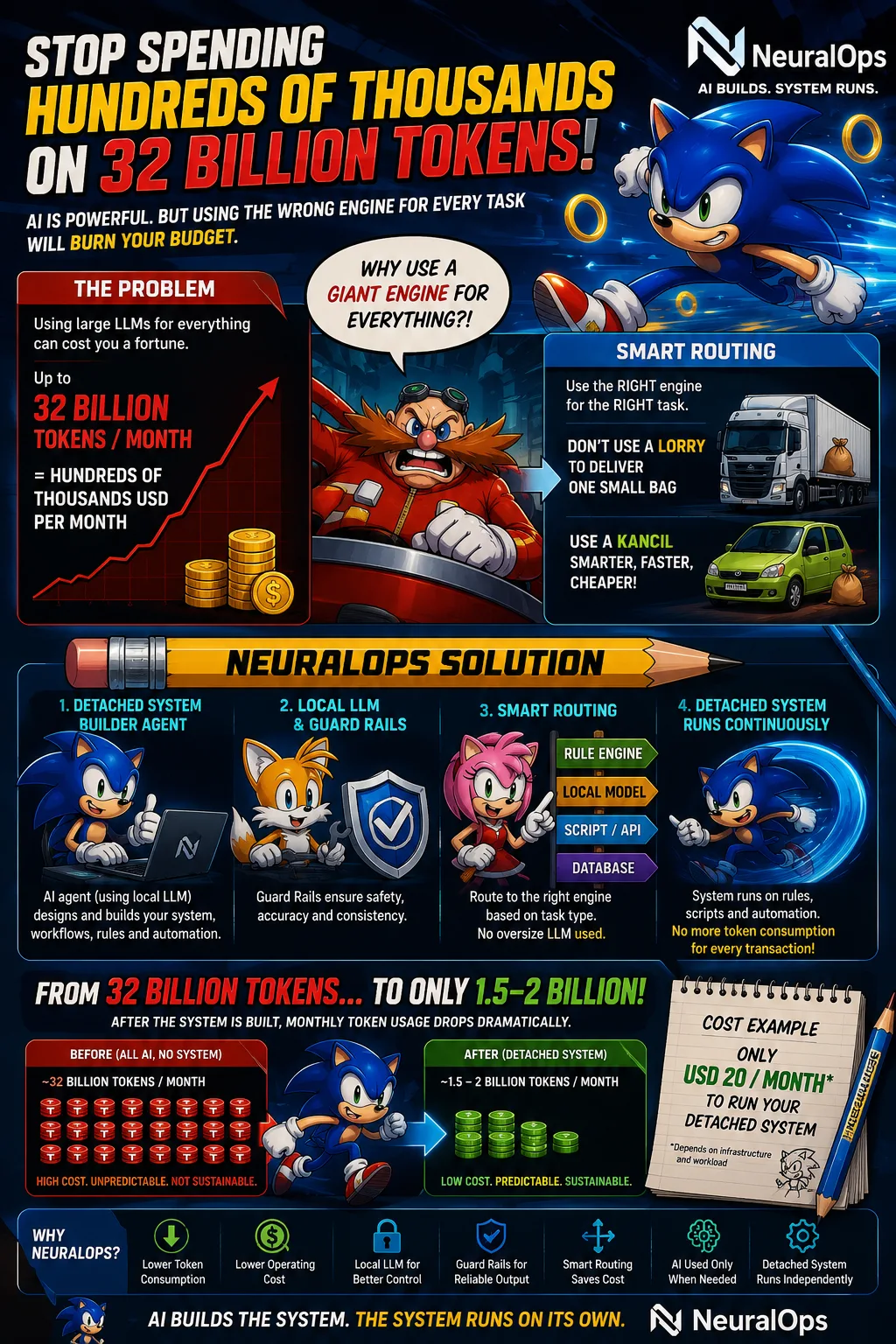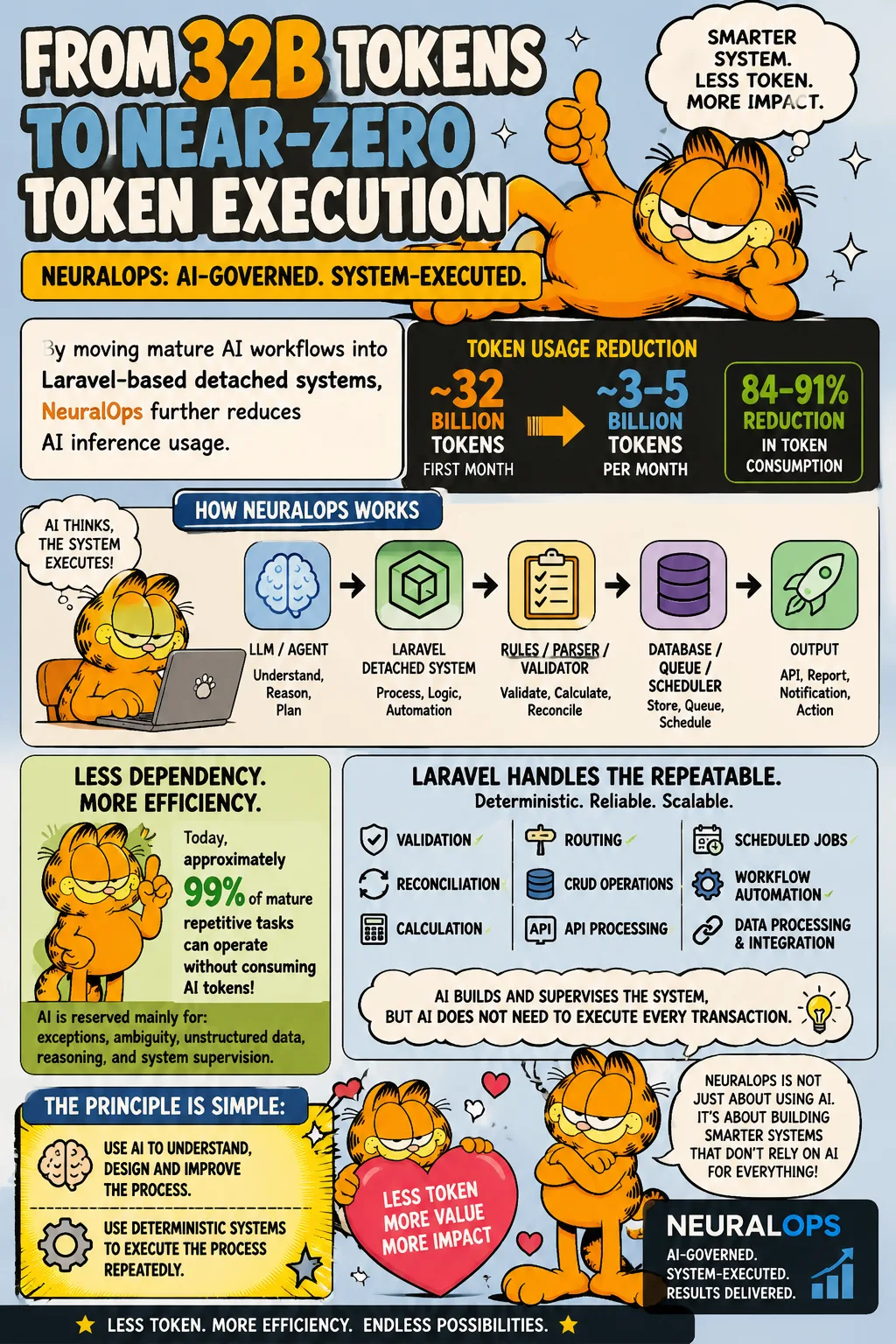
At AINNA, the fastest way we have found to burn through inference budget is to leave an LLM sitting in the hot path for work it already learned. We are changing that by moving stable AI 工作流 into Laravel-based detached execution 系统, which lowers token burn without degrading capability.
After the migration, measured token usage on our NeuralOps 架构 dropped from approximately 32 billion 令牌 in the first month to around 3–5 billion 令牌 per month. That is an estimated 84–91% reduction in token consumption across the same workflow footprint.
As more repetitive, structured pipelines are ported to deterministic Laravel backends, LLM dependency keeps falling. 今天, approximately 99% of mature repetitive tasks can run without consuming any AI 令牌. We reserve the model for the real edge cases: exceptions, ambiguity, unstructured data, reasoning, and 系统 supervision.
The operating principle is simple:
Use neural models to understand the problem, 设计 the flow, and refine it.
Use deterministic 系统 to execute that flow at scale, repeatedly.
This is how NeuralOps is moving from AI-heavy automation toward a more efficient AI-受治理的, 系统-executed architecture.