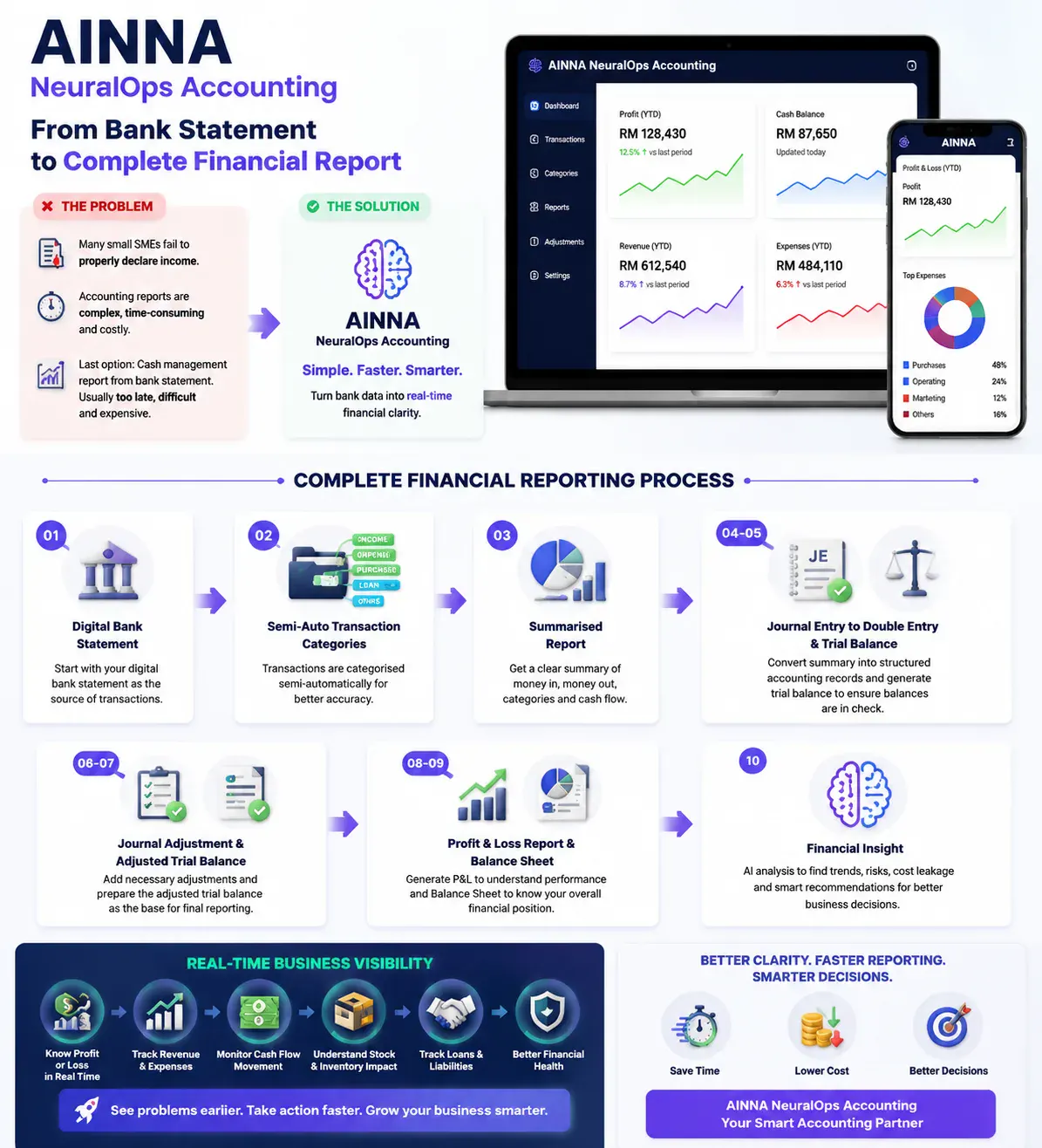
从 a 财务 operations standpoint, many small 马来西亚n 中小企业 under-declare business income and only face tax authority pressure once the shortfall becomes unavoidable. In most cases the root cause is not evasion but a reporting process that is fragmented, slow, and disproportionately costly for the size of the business.
Without an accurate ledger, the fallback is usually a rudimentary cash-based reconciliation built from bank statements. By then the data is messy, adjustments multiply, and remediation cost often exceeds what timely compliance would have cost.
AINNA NeuralOps 会计 is designed to remove that friction.
It converts digital bank statements into a structured, auditable financial reporting workflow that is faster, more accurate, and easier to maintain.
从 源数据 to 管理-就绪 Reports
- 来源: 数字化 银行 Statement
Every accounting period starts with the digital bank statement. It is the most 目标, transaction-level record of cash movement in the business. - Semi-Automated Transaction 分类
交易 are classified semi-automatically so that revenue, operating expenses, purchases, refunds, financing, drawings, and other cash movements are grouped logically from the start. - 现金 位移 摘要
The classified bank data is summarised into a report of money in, money out, account categories, and net cash position. - 结构d 日志 条目 (复式记账)
The summary is posted as structured double-entry records, giving each transaction a clear debit-credit trail. - 试算平衡ance
The double-entry records feed a 试算平衡ance that verifies ledger arithmetic before any final reporting step. - Adjusting 日志 条目
Accruals and adjustments are recorded where required, for example inventory movements, loan interest, depreciation, bank overdrafts, tax provisions, and other 已验证 items. - Adjusted 试算平衡ance
After adjustments are included, the Adjusted 试算平衡ance becomes the authoritative base for final financial reporting. - 利润 & Loss 报告
The 系统 generates a 利润 & Loss report showing revenue, cost of sales, operating expenses, and net profit for the period. - 资产负债表 / Statement of 财务 位置
The 资产负债表 is built by combining the current-year 利润 & Loss, the prior-year closing position as opening equity, and the Adjusted 试算平衡ance. - 财务 洞察
最后, AI analytics interpret the reports, flagging trends, excess costs, cash leakage, weak cost categories, and practical actions for management.
实时 商业 Visibility
Used continuously, the 系统 removes the traditional year-end delay. Owners can see whether the business is profitable without waiting for a manual closing cycle.
As transactions are processed regularly, AINNA NeuralOps 会计 refreshes reports continuously, delivering a near real-time view of financial performance.
This helps 中小企业 owners understand:
- 当前 profit or loss position
- 营收 performance and concentration
- 费用 trends and variances
- 现金 flow movement
- 库存 and inventory impact
- 贷款 commitments
- 总体 financial health
Rather than discovering issues months after they have materialised, management can detect variances early and intervene before they erode cash or profitability.
Why It Matters
Most 中小企业 only learn their true profit or loss once the books are closed. AINNA NeuralOps 会计 makes the financial position visible throughout the year.
It repositions accounting from a backward-looking compliance exercise to a forward-looking management control.
The financial operations 目标 is straightforward:
Cleaner financial data.
Faster month-end and year-end reporting.
更低 operating cost.
Better capital and cost decisions for every 中小企业.














Ruang pembaca
Apa pendapat anda?
Komen disemak sebelum diterbitkan. 电子邮件 diperlukan untuk moderasi dan tidak dipaparkan kepada pembaca.
第一次看到有人把这段说明讲得这么坦白。
同意作者对adjusting 日志 条目 accruals的判断,方向很清楚。
这篇文章对auditable financial reporting workflow的解释很清楚,实际操作的重点也很容易理解。
如果可以继续说明现金 位移 摘要 the classified的真实案例,我会想继续阅读。