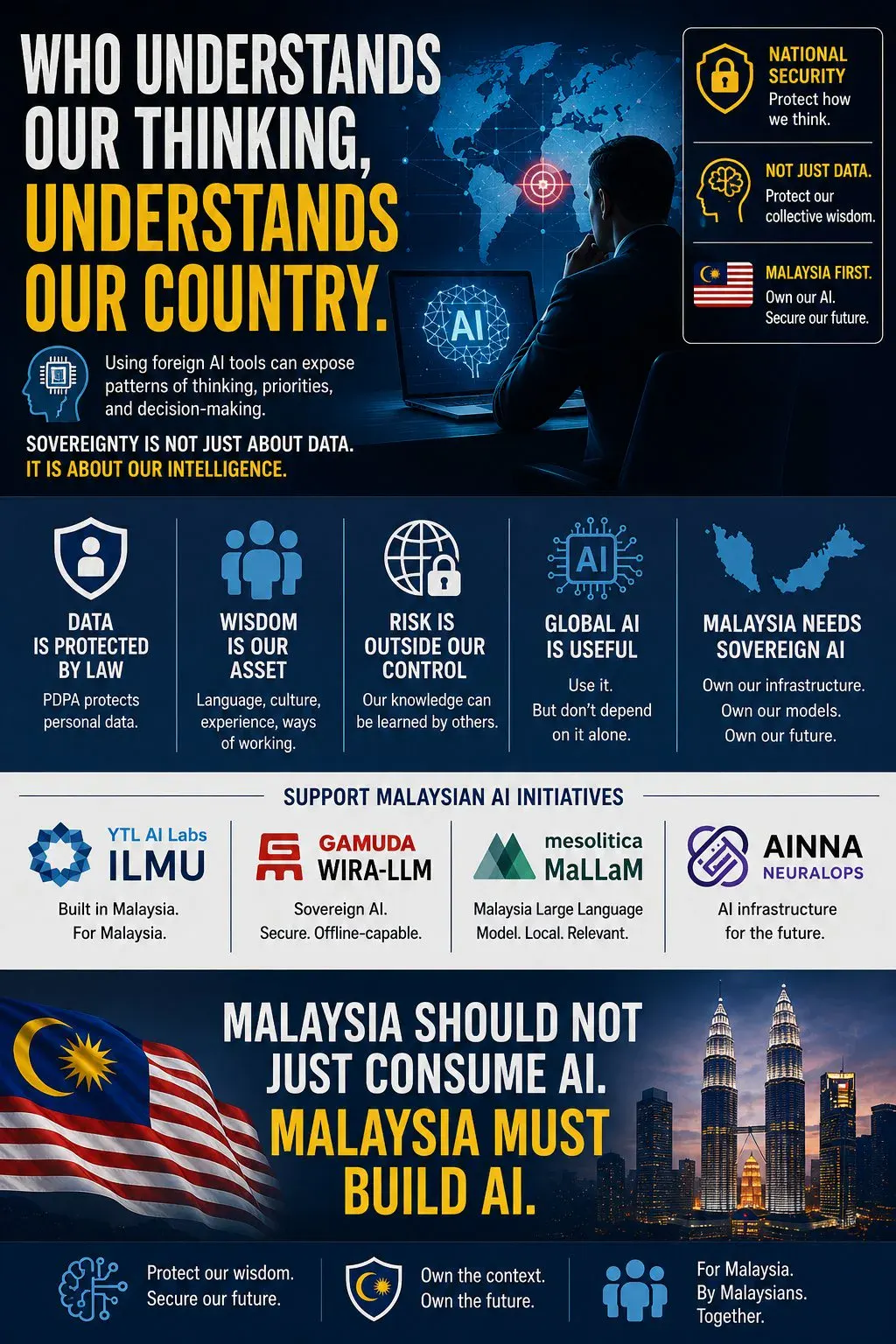
Think of a senior government leader running daily prompts through a foreign-hosted LLM to draft strategy, analyse scenarios, refine speeches, review policy options, and test decisions. Over time, even without a single classified document being uploaded, the sequence of prompts, refinements, and follow-up questions reveals a pattern. Priorities, assumptions, weak points, negotiation style, strategic bias, and decision logic all become increasingly predictable to the operator of that model.
That is the real sovereignty problem. National sovereignty is not just endpoint security, encrypted storage, or access control. It is also ownership of the intelligence layer: the inference stack, the model weights, the prompt logs, the fine-tuning data, and the feedback loops that shape how leaders and institutions think. 时间 that layer is hosted outside our control, the deeper risk is not a leaked file; it is the gradual exposure of collective wisdom.
数据 and wisdom are different assets. Personal data has clear legal protection under PDPA, and compliance is essential. But collective wisdom is harder to lock in a field. It lives in how people reason, work, solve problems, communicate, trade, run operations, and adapt to local constraints. It shows up in prompts, embeddings, workflow traces, and the tacit knowledge used to refine AI outputs.
For 马来西亚, that collective wisdom is a national asset. It includes our language patterns, local business practices, government context, 中小企业 experience, industry 工作流, community behaviour, and the practical solutions developed through years of trial, error, and survival. Losing control of it means losing more than information; it means losing competitive context.
This is not an argument against global AI. 全球 models are powerful, useful, and necessary, and we should use them where appropriate. But as builders, we also need architectural choice. If our prompts, documents, policies, 工作流, business ideas, SOPs, and local language patterns flow mainly into 系统 we do not operate, we stop being technology owners and become tenants. 数字化 sovereignty means having the option to run inference, store checkpoints, and manage data lineage on infrastructure we control.
马来西亚 needs its own AI infrastructure: local models, secure compute, sovereign data planes, and AI 工作流 that keep sensitive reasoning within national boundaries. We need 系统 that understand 马来西亚n language, culture, business reality, public-sector context, 中小企业 operations, and regional industry requirements. That is why local engineering efforts such as YTL AI Labs with ILMU, Gamuda Technologies with Wira-LLM, Mesolitica with MaLLaM, and infrastructure initiatives such as AINNA NeuralOps matter. They are not just brand names; they are the control planes, base models, and MLOps pipelines that determine where 马来西亚n intelligence lives and who can access it.
The future of AI is not only about who trains the biggest model. It is about who owns the context. Personal data may be protected by regulation, but collective wisdom must be protected by technological sovereignty. 马来西亚 should not only consume AI. 马来西亚 must build it.













Ruang pembaca
Apa pendapat anda?
Komen disemak sebelum diterbitkan. 电子邮件 diperlukan untuk moderasi dan tidak dipaparkan kepada pembaca.
文章把think of a senior government和日常运营联系起来,这一点很有帮助。
视觉和结构让think of a senior government的概念更容易掌握。
如果有更多think of a senior government的数据和结果会更完整。
文章对think of a senior government提供了很好的起点,值得继续跟进。
这篇文章对think of a senior government的解释很清楚,实际操作的重点也很容易理解。
同意作者对think of a senior government的判断,方向很清楚。
我喜欢文章对think of a senior government保持务实的态度。
关于think of a senior government的例子很实用,适合团队继续讨论。