ESG, to me, is not just about reporting, certification, or green marketing.
It starts with a much simpler question:
Can we achieve the same - or better - outcome while consuming significantly fewer resources?
In AI development, I see many systems relying on large models for almost every task.
But not every task requires heavy AI reasoning.
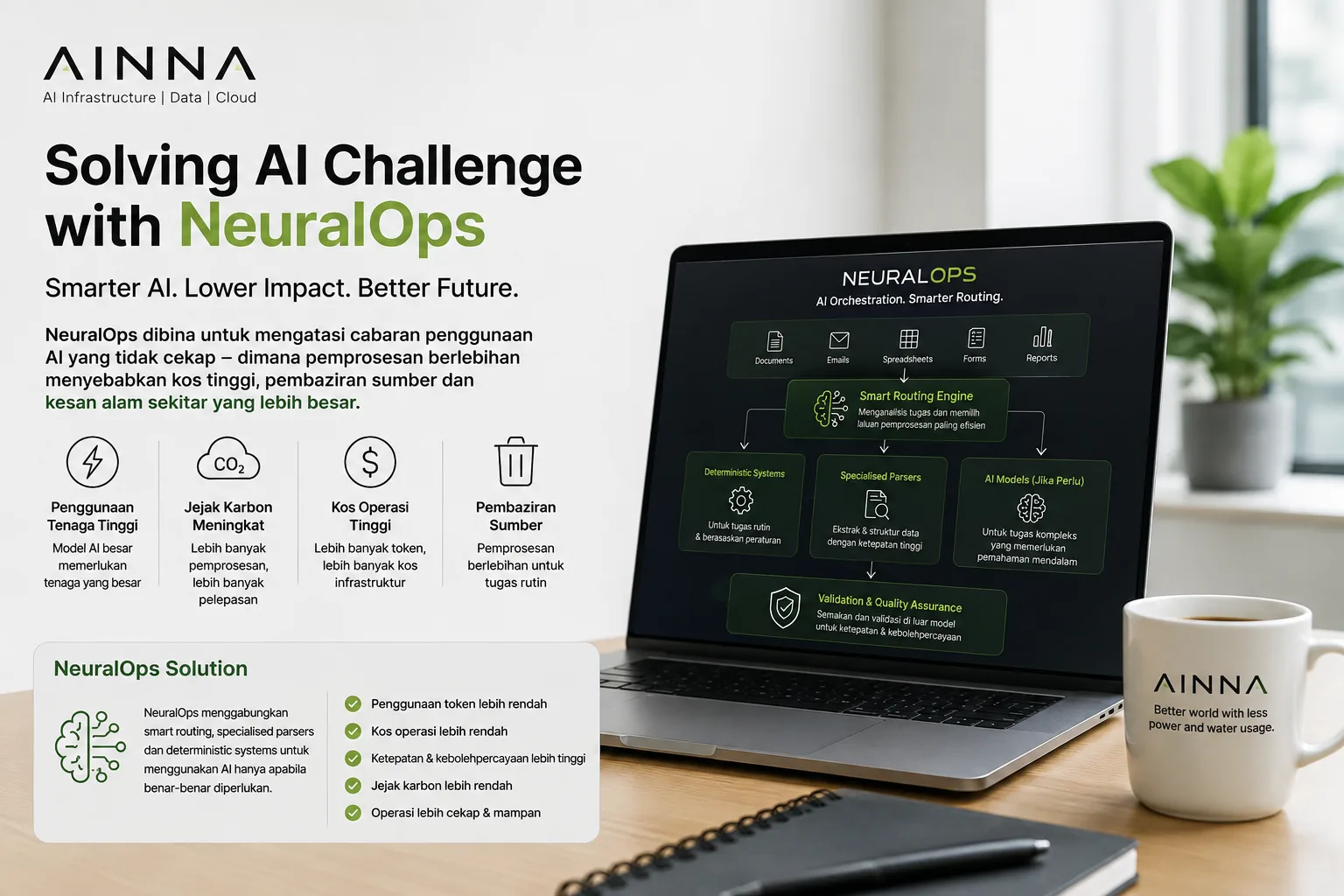
At AINNA, through NeuralOps, we are exploring a different approach.
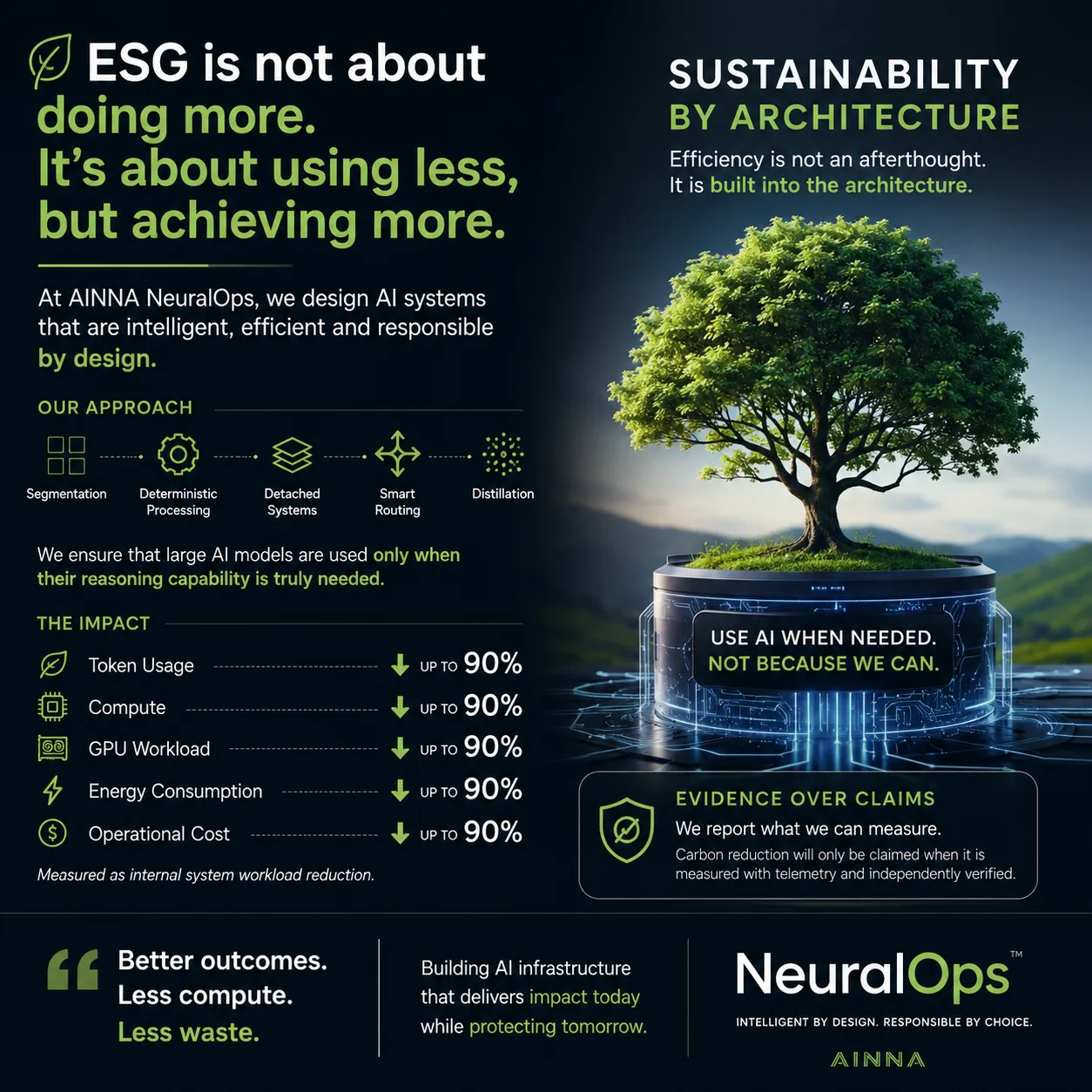
We use segmentation, deterministic processing, detached systems, 智能路由, and model distillation so that larger AI models are used only when their reasoning capability is genuinely required.
The objective is straightforward:
Reduce 令牌.
Reduce compute.
Reduce GPU workload.
Reduce energy consumption.
Reduce operational cost.
While maintaining - or improving - the business outcome.
For me, this is a more practical interpretation of ESG:
可持续发展 by architecture.
Instead of adding an “ESG layer” after a 系统 has already been built, we should 设计 technology from the beginning to consume fewer resources.
There is another principle I believe is equally important:
Do not overclaim.
If we 测量 a significant reduction in processing workload, we should report it as a measured 系统 result.
But if carbon reduction has not yet been properly measured through telemetry and independently validated, it should not become a marketing number.
Because meaningful ESG requires evidence.
更好的结果s. 更少算力. Less waste.
That is the direction we are pursuing with NeuralOps - building AI infrastructure where efficiency is not an afterthought, but part of the architecture itself.
#ESG #SustainableAI #GreenAI #ArtificialIntelligence #NeuralOps #AIInfrastructure #可持续发展 #DigitalTransformation #SovereignAI #创新 #AINNA